
Quick Answer: How to Turn On a Lawn Mower
Gas push mower: Engage the safety bail bar, set the choke to closed (cold start), press the primer bulb 3 times, move the throttle to Fast/Run, then pull the recoil cord in one firm, smooth stroke. Riding mower: Sit in the seat, set the parking brake, disengage the blade engagement lever, then turn the ignition key to Start. Battery or corded electric mower: Insert a charged battery (or plug in the extension cord), press and hold the safety interlock button, and squeeze the handle bail. Exact steps vary by mower type and engine brand — full procedures for each type follow below.
What You Need to Know Before Starting Any Lawn Mower (Safety Checks)
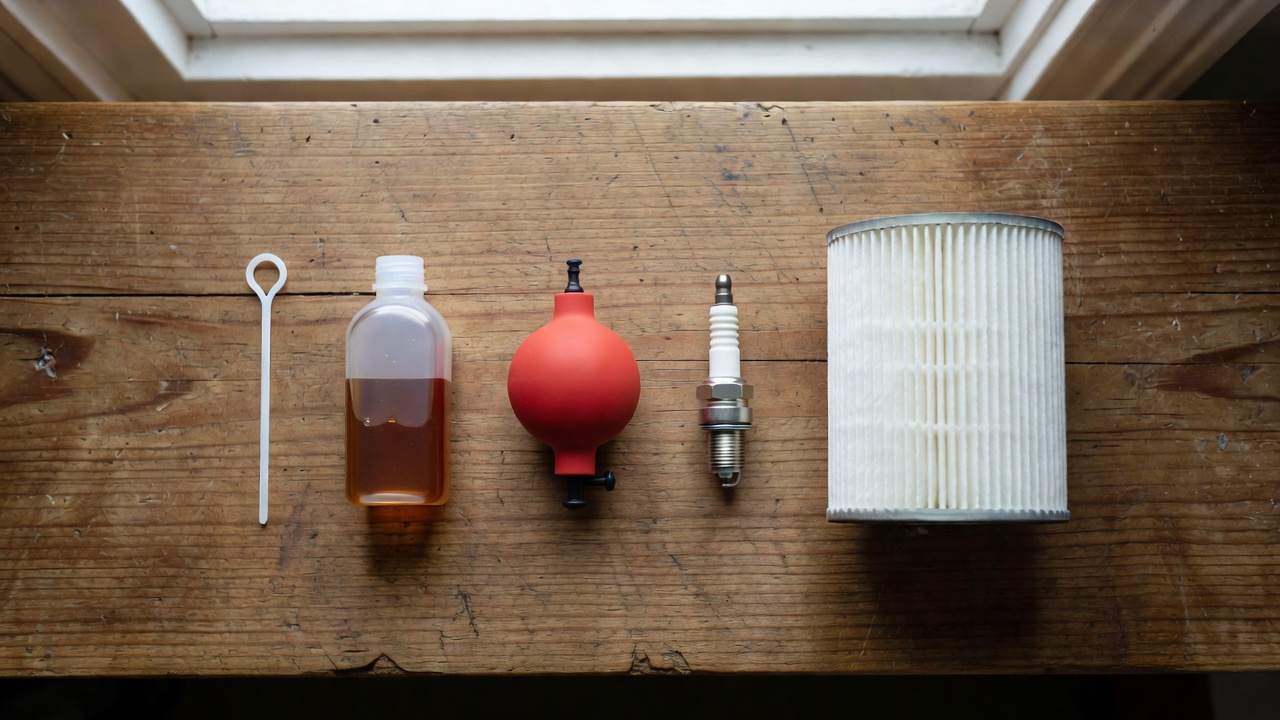
Skipping pre-start checks is the leading cause of equipment damage and operator injury. Complete every item on this list before touching a start control — regardless of mower type.
Check Oil Level
Pull the dipstick, wipe it clean, reinsert fully, then pull again. Oil should sit between the MIN and MAX marks. Running a gas engine low on oil causes irreversible cylinder damage within minutes. Use the viscosity grade stamped on the engine shroud (commonly SAE 30 or 10W-30).
Check Fuel Level and Fuel Quality
Ethanol-blended gasoline (E10) begins degrading in as little as 30 days without a fuel stabilizer, forming varnish deposits that clog carburetor jets. If fuel has sat in the tank over winter or longer than 30 days, drain it and refill with fresh gasoline before attempting a start. Most consumer gas mowers require regular unleaded (87 octane) with no more than 10% ethanol; consult your engine manual before using E15 or E85. Users looking for related component recommendations can explore our jbl partybox club 120 vs sony srs xv500 breakdown.
Inspect the Cutting Area
Walk the mowing area and remove rocks, sticks, toys, hoses, and any debris. A mower blade spinning at 3,000 RPM converts a small stone into a high-velocity projectile. Users looking for related component recommendations can explore our jbl partybox club 120 vs sony srs xv500 breakdown.
Personal Protective Equipment (PPE)
- Closed-toe shoes — mandatory; no sandals or bare feet near any mower
- Eye protection — safety glasses or goggles protect against ejected debris
- Hearing protection — gas mowers typically operate at 85–95 dB; prolonged exposure causes hearing loss
- Long pants — reduces laceration risk from debris discharge
Carbon Monoxide Warning
Never start or run a gas-powered mower indoors, in a garage, or in any enclosed or partially enclosed space. According to the U.S. Consumer Product Safety Commission (CPSC), gas-powered lawn equipment is a leading source of non-fire carbon monoxide poisoning. CO is odorless and colorless; incapacitation can occur within minutes at high concentrations. Start and operate gas mowers exclusively in open outdoor areas.
Inspect the Air Filter and Spark Plug (Quick Visual)
A clogged air filter starves the engine of oxygen; a fouled spark plug fails to ignite the fuel-air mixture. Before the first start of the season, pull the air filter and tap it clean (paper element) or wash it (foam element). Visually inspect the spark plug for cracked porcelain, heavy carbon buildup, or a worn electrode — replace if in doubt. Briggs & Stratton and Honda both recommend spark plug replacement every 100 operating hours or once per season, whichever comes first. Before finalizing equipment decisions, refer to our comprehensive z890 vs x870e motherboard comparison.
How to Turn On a Gas Push Mower (Step-by-Step)
Gas push mowers are the most common type. Most use either a Briggs & Stratton or Honda engine; the start sequence below applies to both with minor label differences.
Cold Start Procedure (Engine Has Not Run Recently)
- Position the mower on a flat, open surface. Ensure the discharge chute faces away from people and structures.
- Set the choke lever to CLOSED (or CHOKE). Closing the choke restricts airflow into the carburetor, enriching the fuel-air mixture — necessary to fire a cold engine. The lever is typically located on the engine shroud and labeled with a choke symbol or Open/Close text.
- Move the throttle to FAST or RUN. On most engines this is a separate lever or integrated into the choke/throttle panel. Starting at a fast throttle setting delivers adequate RPM to keep a cold engine running.
- Press the primer bulb 3 times. The primer bulb is a small rubber dome (usually red or black) on the carburetor body. Each press purges air from the fuel line and delivers a metered shot of gasoline directly to the carburetor bowl. Three presses is the standard recommendation from both Briggs & Stratton and Honda for a cold engine at normal temperatures; press up to 5 times in cold weather below 50°F (10°C). Do not over-prime — excessive fuel floods the engine.
- Engage the safety bail bar. The bail bar (also called the operator presence control or dead-man lever) is the U-shaped handle bar you squeeze against the main handle. Federal blade-control safety standards require this switch; the engine will not start unless the bail is held firmly. Keep it held throughout operation — releasing it stops the engine and, on blade-brake models, halts the blade within 3 seconds.
- Pull the recoil starter cord. Grip the handle firmly, pull straight out in one smooth, rapid stroke — do not yank at an angle or let the cord snap back uncontrolled. A controlled recoil prevents cord fraying and hand strain. The engine should fire within 2–3 pulls on a properly primed, well-maintained mower.
- Open the choke after the engine warms up. Once the engine runs steadily (typically 30–60 seconds), move the choke lever back to OPEN or RUN. Leaving the choke closed on a warm engine causes rough running and excessive fuel consumption.
Warm Start Procedure (Engine Ran Within the Last Hour)
- Set the choke to OPEN — the engine is already warm and does not need an enriched mixture.
- Set the throttle to FAST.
- Press the primer bulb 1–2 times (some engines need none when warm).
- Engage the bail bar and pull the recoil cord.
How to Turn On a Riding Lawn Mower (Step-by-Step)
Riding mowers use ignition-key starts and incorporate multiple safety interlock switches that must all be satisfied before the engine cranks. Attempting to bypass these switches is dangerous and voids most warranties. For broader ecosystem context, read through our operational guide on marshall stanmore iii vs harman kardon onyx studio 8.
- Sit fully in the operator seat. The seat safety switch is a pressure sensor beneath the seat cushion. It prevents the engine from cranking — or cuts the engine — if the operator leaves the seat while the blades are engaged. The seat must be occupied throughout operation.
- Set the parking brake. Engage the parking brake lever or pedal (location varies by brand; consult your operator manual). Most ignition interlocks on riding mowers require the parking brake to be set before the engine will crank.
- Disengage the blade engagement lever (PTO). The blade engagement lever or Power Take-Off (PTO) switch must be in the OFF or DISENGAGED position before starting. Attempting to start with blades engaged overloads the starter motor and is a safety hazard.
- Set the throttle to the START or HALF position. Some riding mowers have a dedicated choke control (especially older carbureted models); set it to CHOKE for a cold start. Many modern riding mowers with automatic choke systems (including most Husqvarna and John Deere models with Briggs & Stratton Intek engines) handle choke automatically — check your manual.
- Insert the ignition key and turn to START. Turn the key clockwise to the START position and hold it until the engine fires — do not hold for more than 5 seconds continuously to avoid overheating the starter motor. If the engine does not start within 5 seconds, release the key to the OFF position, wait 10 seconds, then try again.
- Release the key to the RUN position once the engine starts. Open the choke (if manually controlled) after 30–60 seconds of warm-up.
- Allow a brief warm-up period (1–2 minutes at low throttle) before engaging the blades and beginning to mow.
Why won’t the riding mower crank when I turn the key? The most common cause is an unsatisfied safety interlock: the seat switch is not depressed, the parking brake is off, or the blade engagement lever is in the ON position. Verify all three before suspecting a dead battery or faulty starter.
How to Turn On a Battery-Powered (Cordless Electric) Lawn Mower
Cordless electric mowers have no choke, no primer bulb, and no pull cord. The start process is simpler but has its own safety interlocks. For troubleshooting and reliability insights, consult our in-depth dyson v8 cyclone vs bissell featherweight stick report.
- Verify battery charge level. Most major OEMs (EGO, Greenworks, Ryobi) recommend charging the battery to full (100%) before the first use of the season. A battery below approximately 20% charge may not deliver sufficient amperage to engage the blade motor under load — the mower will power on but stall in thick grass. Check the battery’s LED charge indicator before inserting it.
- Insert the battery pack into the mower’s battery compartment until it clicks and locks. Using a partially seated battery causes intermittent power loss and can damage the battery contacts.
- Press and hold the safety interlock button. This is typically a small button on the handle or top deck that must be held simultaneously with the bail bar to prevent accidental starts. The button location varies by brand — EGO places it on the handle; Ryobi places it on the top of the deck near the handle.
- Squeeze the handle bail while continuing to hold the safety interlock button. The blade engages and the mower is now operating.
- Release either control to stop. Releasing the handle bail or the interlock button cuts power to the blade immediately.
Battery storage note: Lithium-ion batteries stored at 0% charge for extended periods suffer capacity loss. Store batteries at 40–80% charge in a cool, dry location when the mower is not in use for more than a few weeks.
How to Turn On a Corded Electric Lawn Mower
Corded electric mowers are the simplest type to start but require attention to extension cord specifications to avoid voltage drop, overheating, or tripped breakers. Readers comparing setup options can review our technical analysis on bissell crosswave hydrosteam vs shark stainforce.
Extension Cord Requirements
| Cord Length | Minimum Wire Gauge | Required Rating |
|---|---|---|
| Up to 50 ft (15 m) | 14 AWG | Outdoor-rated (SJTW or SJTOW) |
| 50–100 ft (15–30 m) | 12 AWG | Outdoor-rated (SJTW or SJTOW) |
| Over 100 ft (30 m) | Not recommended | Excessive voltage drop damages motor |
Always use an outdoor-rated three-prong grounded extension cord. Using an indoor or two-prong cord with a corded electric mower is a shock and fire hazard.
Start Procedure
- Connect the mower cord to the extension cord and the extension cord to a grounded outdoor outlet. Lay the cord behind you and away from the cutting path to avoid running it over.
- Locate the power switch or key (some models have a removable safety key that must be inserted before the mower can start — store this key when the mower is unattended).
- Press and hold the safety interlock button on the handle.
- Squeeze the handle bail lever. The motor engages. Release either control to stop.
Corded electric mowers have no choke, no primer, no oil to check (no engine), and no fuel. The only pre-start checks are cord condition (no cuts, fraying, or exposed wiring) and blade condition.
Cold Start vs. Warm Start: Key Differences to Know
The single most common reason a gas mower fails to start correctly is using the wrong choke position for engine temperature. Understanding the difference prevents a flooded engine and wasted effort.
Cold Start (First Start of the Day or After Sitting)
A cold engine has no residual fuel vapor in the carburetor. Choke CLOSED restricts incoming air, forcing a richer (more fuel-heavy) fuel-air mixture that a cold engine needs to combust reliably. Use full choke, prime 3 times, and expect to pull 2–4 times before ignition.
Warm Start (Engine Ran Within the Past Hour)
A warm engine has residual heat and fuel vapor present. Closing the choke delivers excess fuel, flooding the engine. Choke OPEN, reduced or no priming, and the engine should start on the first or second pull.
Flooded Engine Recovery
A flooded engine has too much raw gasoline in the cylinder, preventing ignition. Symptoms: strong fuel smell from the exhaust, engine cranks but won’t fire, black smoke on brief starts.
- Set the choke to OPEN (fully open, no choke).
- Move the throttle to FAST.
- Do not press the primer bulb again.
- Pull the recoil cord 6–10 times to purge excess fuel through the cylinder.
- Wait 10–15 minutes for fuel to evaporate, then attempt a normal warm-start sequence.
For first-start-of-season guidance after winter storage — including fuel draining, carburetor cleaning, and battery conditioning — see our dedicated article: how-to-start-a-lawn-mower-after-winter”>How to Start a Lawn Mower After Winter.
Lawn Mower Won’t Start? Quick Troubleshooting Checklist
Work through this checklist in order before assuming a major mechanical failure. Most no-start conditions have a simple cause.
| Symptom | Likely Cause | Quick Fix |
|---|---|---|
| Engine cranks, won’t fire | Stale fuel or flooded engine | Drain old fuel; use flooded engine recovery procedure above |
| No crank, no sound (gas mower) | Unsatisfied safety interlock (bail bar, seat switch, brake) | Verify all operator controls are correctly positioned |
| Weak/sputtering start | Clogged air filter or dirty carburetor | Clean or replace air filter; inspect carburetor jets |
| No spark | Fouled or failed spark plug | Remove, inspect, and replace spark plug — gap to spec in engine manual |
| Riding mower key turns, no crank | Dead battery or faulty seat/brake interlock | Test battery voltage (should read ~12.6 V); check all interlock switches |
| Cordless mower powers on but won’t cut | Battery below minimum charge threshold | Charge battery to full before use |
| Engine runs rough after start | Choke left in CLOSED position after warm-up | Move choke lever to OPEN after 30–60 seconds |
Stale fuel detail: Ethanol-blended gasoline (E10) begins oxidizing and forming varnish deposits in as little as 30 days. Always add a fuel stabilizer (such as Sta-Bil) if the mower will sit unused for more than 30 days. For deep-dive no-start diagnosis — including carburetor cleaning, ignition coil testing, and safety switch bypass testing — see our full guide: Lawn Mower Won’t Start: Complete Troubleshooting Guide.
Common Questions on How To Turn On The Lawn Mower Answered
How many times do I press the primer bulb on a lawn mower?
Press the primer bulb 3 times for a standard cold start at normal temperatures (above 50°F/10°C). This is the recommendation published in Briggs & Stratton and Honda engine operator manuals for most consumer push mower engines. In cold weather below 50°F, press up to 5 times. For a warm engine that ran within the last hour, press 1–2 times or skip priming entirely. Never press more than 5–6 times — over-priming floods the engine with raw fuel, preventing ignition.
Should the choke be open or closed when starting a cold lawn mower?
Closed (full choke) for a cold start. Closing the choke lever restricts airflow into the carburetor, producing a fuel-rich mixture that a cold engine requires to fire reliably. Once the engine has run for 30–60 seconds and smooths out, move the choke to the open position. Starting a cold engine with the choke open is one of the most common reasons a mower won’t start on the first several pulls.
Why does my riding mower click but not start when I turn the key?
A single loud click typically indicates a dead or low battery — the starter solenoid is engaging but the battery lacks sufficient current to spin the starter motor. Check battery voltage with a multimeter (a healthy 12V mower battery reads 12.4–12.6 V at rest). A rapid clicking sound often signals the same problem. If the battery tests good, the fault shifts to a faulty starter solenoid, corroded cable connections, or a failed starter motor. Also confirm all safety interlocks (seat, brake, blade engagement) are correctly positioned, as a tripped interlock produces no click at all — the circuit is simply open.
Is it safe to start a lawn mower in the garage with the door open?
No — do not start or run a gas-powered lawn mower in a garage, even with the door open. An open garage door does not provide adequate ventilation to prevent dangerous carbon monoxide accumulation. The CPSC documents numerous CO poisoning deaths linked to gas-powered lawn equipment operated in partially open structures. Start and operate gas mowers exclusively in open outdoor areas, a minimum of several feet from any doorway, window, or vent opening that could allow exhaust to enter a building.

Pros
- Powerful 80V brushless motor delivers 32HP gas-equivalent performance with quiet fume-free operation and no engine maintenance.
- Complete kit includes four 6.0Ah batteries and 600W charger for substantial runtime up to 1.5 acres.
- SmartCut technology and 42-inch heavy-duty steel deck ensure consistent cuts without bogging in tough conditions.
- Versatile towing up to 350 lbs and optional cargo hauling plus comfort features like high-back seat and LED lights.
- Strong 4-year limited warranty and full compatibility with the Greenworks 80V tool ecosystem.
Cons
- Rear utility cargo bed for 200 lb hauling is sold separately and not included in the kit.
- Runtime of up to 1.5 acres varies with conditions and may require recharging or battery swaps on larger properties.
- As a fully cordless model continuous operation depends on battery levels unlike gas engines with unlimited runtime.
The Greenworks 80V 42" CrossoverT Cordless Riding Lawn Tractor is a ready-to-mow zero-emission tractor designed for homeowners managing medium to large lawns. It features a reinforced 42-inch stamped steel deck of 12-gauge construction along with premium comfort elements such as a high-back padded seat with foldable armrests. The overall build emphasizes durability and user convenience right out of the box with the included battery and charger set.
Performance centers on the 80V TruBrushless motor that provides 32HP gas-equivalent power with instant torque and quiet fume-free operation. SmartCut technology senses grass conditions and automatically adjusts power to maintain a consistent cut even in tall thick or wet areas. The four 6.0Ah batteries support runtime for up to 1.5 acres depending on conditions while dual LED headlights and a 7-position deck height range from 1.5" to 4.5" add practicality. Front and rear attachments further allow towing up to 350 lbs for added yard utility.
Key considerations include that the rear utility storage bin capable of hauling 200 lbs is sold separately so full cargo functionality requires an extra purchase. Runtime remains condition-dependent and may fall short for properties significantly larger than 1.5 acres without using the 600W charger or swapping batteries. The cordless design prioritizes ease and low maintenance but trades off the continuous runtime of traditional gas models.
This tractor delivers strong value for eco-conscious owners of residential properties who want gas-like power without the emissions noise or upkeep. It suits those who already use or plan to expand into the Greenworks 80V family of tools and who appreciate the 4-year limited warranty. Users with exceptionally large or commercial-scale lawns should evaluate battery logistics carefully before purchase.

Pros
- Delivers strong 21 horsepower equivalent power comparable to gas riding mowers.
- Provides up to 1.5 acres of runtime on a full charge with the six included batteries.
- Features low-maintenance dual brushless motors without belts for greater durability.
- Offers versatile 12-position cutting height adjustment from 1.5 to 4.5 inches.
- Includes digital controls for blade settings, drive speeds, and cruise control.
Cons
- Limited to 1.5 acres of cutting per charge without purchasing additional batteries for bigger lawns.
- Requires recharging time for the six 56V batteries after each use session.
- Relies solely on battery power with no hybrid or gas backup option for extended operation.
The EGO Power+ TR4204 is a cordless electric riding lawn mower built as a modern tractor alternative for residential use. It features a robust 42-inch stamped steel deck and arrives ready to go with six 56V 6.0Ah batteries plus a charger, creating an immediate impression of convenience and solid construction free from gas engine complexity.
Performance shines through its equivalent 21 horsepower output and top speed of 6 MPH, allowing efficient coverage of up to 1.5 acres on a single charge. Dual brushless cutting motors operate without belts for added durability and less upkeep, while the digital display lets users select three blade settings, three drive speeds, and cruise control. The 12 adjustable heights ranging from 1.5 to 4.5 inches combined with anti-scalp wheels deliver precise results across varied terrain.
Drawbacks center on battery dependency, as larger properties beyond 1.5 acres require extra batteries and recharging intervals can interrupt workflow. The fully electric design eliminates fuel storage needs but demands access to power sources between sessions.
This mower suits homeowners with medium to large yards who value quiet, emission-free operation and reduced maintenance. Those seeking expandable battery capacity for bigger areas will find the EGO Power+ TR4204 a strong long-term investment in cordless lawn care.
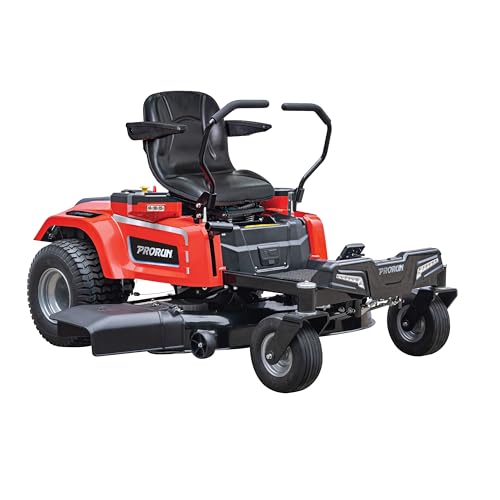
Pros
- High-efficiency brushless motors maximize power output and durability over traditional motors
- Up to 2 acres runtime with three included 10.0 Ah batteries supports substantial mowing sessions
- Zero-emission operation with gas-equivalent 20 HP power for quieter environmentally friendly use
- Six-port auto-switchover battery system provides flexible extended runtime options
- Durable 42-inch steel deck plus included mulch and towing kits add immediate functionality
Cons
- Runtime is limited to approximately 70 minutes or 2 acres which may require recharging for larger properties
- Fully battery-dependent design means performance relies on charge levels and spare battery availability
- 42-inch deck size may require more passes on expansive lawns compared to wider commercial models
The PRORUN PZT60V42 is a fully electric 60V zero-turn riding lawn mower built for residential and light commercial use. Its primary design centers on a robust 42-inch 14-gauge stamped steel twin blade deck powered by direct-drive brushless motors, giving an immediate impression of solid construction and modern battery-focused engineering. The mower arrives complete with three 10.0 Ah batteries, a charger, mulch kit, and towing kit for ready-to-work versatility.
In performance terms, four high-efficiency brushless motors deliver power equivalent to a 20 HP gas engine while producing zero emissions. The system supports up to 2.0 acres or 70 minutes of runtime, and six battery ports with auto switchover intelligently manage all PRORUN 60V battery sizes for continuous operation. A washout port on the steel deck further simplifies post-mow maintenance during real-world sessions.
Potential drawbacks include the finite 70-minute runtime window which can limit coverage on larger properties without spare batteries or recharge breaks. As a fully electric model, it also depends entirely on battery charge levels rather than continuous fuel refills, and the 42-inch deck width may demand extra passes compared with wider traditional options.
Overall the PRORUN PZT60V42 offers strong value for homeowners and small-property managers who want gas-like cutting power without emissions or noise. Those with medium-sized lawns seeking quiet efficient zero-turn performance and included accessories will benefit most from this electric mower.

Pros
- Strong 24HP FR730 engine power for demanding cutting conditions
- Wide 54-inch FAB deck reduces total mowing time
- Zero turn design delivers excellent maneuverability
- Fabricated deck supports durable everyday operation
Cons
- Sparse details beyond engine and deck leave other features unspecified
- Gas-powered FR730 engine needs regular fuel and maintenance
- Large 54-inch deck size may feel oversized on compact properties
The Husqvarna Z254F is a zero turn mower from the established Husqvarna brand in the riding lawn mowers category. It centers on a solid build that pairs a 24HP 726cc FR730 engine with a 54-inch FAB deck for straightforward residential grass care.
Performance stems directly from the listed specifications. The FR730 engine delivers the horsepower needed for steady operation across typical lawns while the wide FAB deck completes passes efficiently. Zero turn handling improves control in real yard layouts based on the model design.
Considerations arise from the limited data available. Secondary elements such as comfort features fuel capacity or extras receive no mention and the gas engine format involves routine upkeep. The large deck suits open areas better than confined spaces.
The Husqvarna Z254F provides the most value for owners of medium or large properties who want reliable engine power and a broad cutting width. Users with smaller lots or those seeking extensive accessory options should weigh the core specs carefully before purchase.
Mechanical safety standards, operational tolerances, and protective gear guidelines align with benchmark specifications established by the American National Standards Institute (ANSI).