What Is CFM on a Leaf Blower?
CFM stands for cubic feet per minute, and it measures the volume of air a leaf blower moves in one minute. Think of it as the quantity of air being pushed out—essentially how much air is flowing from the blower’s nozzle. A leaf blower with 500 CFM moves 500 cubic feet of air every 60 seconds, while one with 800 CFM moves 800 cubic feet in the same timeframe.
CFM is the most important performance specification when evaluating a leaf blower because it directly correlates to cleaning power. Higher CFM means your blower can move more air, which allows it to push heavier debris, clear larger areas faster, and handle tougher jobs like wet leaves or grass clippings. For most homeowners, understanding CFM is more critical than any other spec because it determines whether a blower will efficiently handle your yard’s needs.
How CFM Is Measured
CFM is measured using standardized testing protocols. Manufacturers place the blower in a controlled environment and calculate the volume of air moving through the nozzle per minute. The measurement is typically taken at the blower’s maximum throttle setting. However, CFM can vary slightly depending on nozzle type, air density, and testing conditions, which is why you may see different CFM ratings from different sources for the same model.
CFM vs. MPH: Understanding Both Metrics
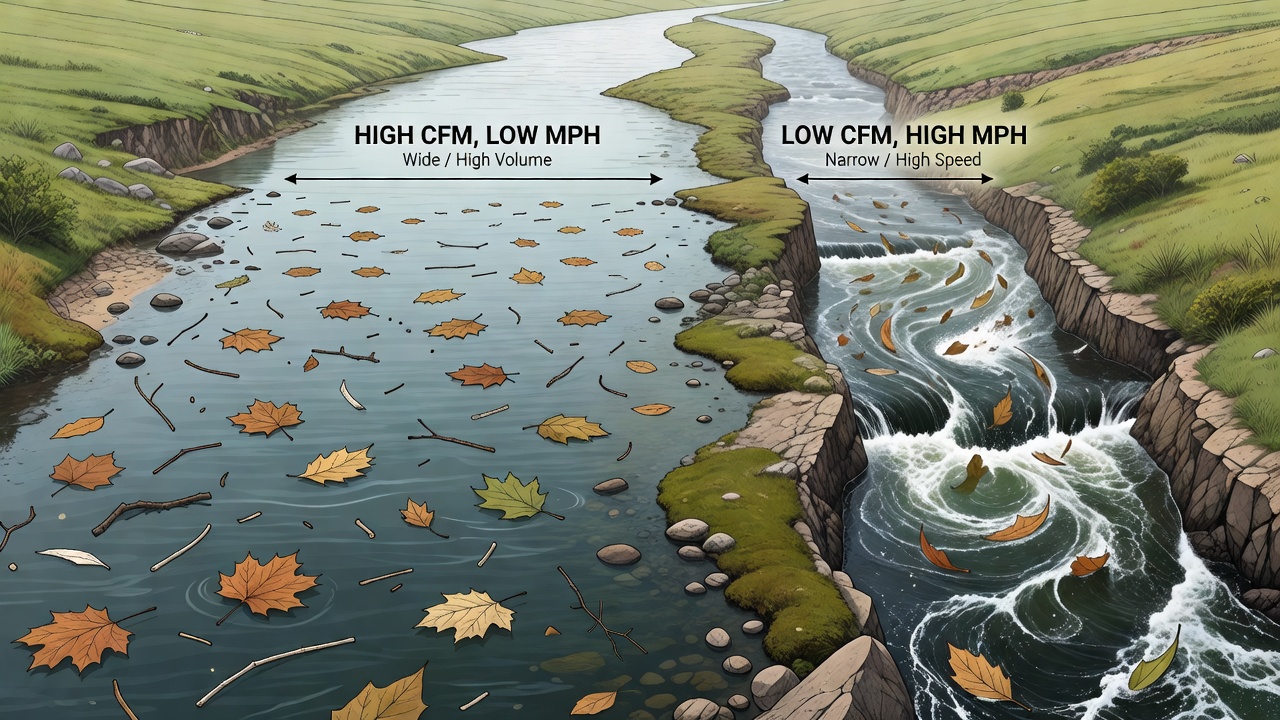
Many people confuse CFM with MPH (miles per hour), but they measure different aspects of blower performance:
- CFM (cubic feet per minute) = air volume or quantity of air being moved
- MPH (miles per hour) = air speed or how fast that air is traveling
To use an analogy: CFM is like the width of a river (how much water flows), while MPH is like the river’s current speed (how fast it flows). A leaf blower with high CFM but low MPH produces a lot of air moving slowly, while high MPH with low CFM produces a smaller, faster-moving stream of air.
Which Metric Matters More?
For most residential yard work, CFM is more important than MPH. Here’s why:
- CFM determines overall cleaning power—it’s what moves heavy, wet leaves and stubborn debris
- MPH helps with reach and speed—higher MPH means you can move debris further and faster, but it’s secondary to volume
- Most residential tasks (clearing driveways, patios, light yard cleanup) benefit more from higher CFM than from extreme MPH ratings
That said, you want a reasonable balance of both. A blower with 600 CFM at 150 MPH will outperform a 600 CFM blower at 100 MPH for the same basic task. Ideally, look for models that offer solid CFM with MPH in the 100–200 range for handheld blowers and 150–250 MPH for backpack models.
Typical CFM Ranges by Blower Type
| Blower Type | Typical CFM Range | Best For |
|---|---|---|
| Handheld Electric (Corded) | 200–400 CFM | Small yards, light cleanup, precise work |
| Handheld Battery-Powered | 300–600 CFM | Small to medium yards, convenience and quiet operation |
| Handheld Gas-Powered | 400–700 CFM | Medium yards, general-purpose residential use |
| Backpack Blower | 600–1,200 CFM | Large properties, commercial work, heavy debris |
| Wheeled/Handheld Combination | 800–1,500+ CFM | Professional landscaping, large-scale properties |
Most homeowners find success with handheld blowers in the 400–650 CFM range. These offer enough power for typical residential tasks without being overpowering or unnecessarily loud.
How CFM Affects Real-World Blower Performance
Debris Clearing Speed and Effectiveness
Higher CFM directly translates to faster debris clearing and the ability to handle tougher material:
- 300–400 CFM: Moves light, dry leaves and small debris. May struggle with wet leaves, grass clippings, or dense pile-ups
- 500–650 CFM: Handles most residential leaves and debris effectively. Can clear mixed debris (dry and slightly damp) without difficulty
- 700+ CFM: Moves heavy, wet leaves, sand, gravel, and stubborn debris. Designed for professional or high-demand use
Area Coverage and Task Suitability
CFM determines what tasks are practical for a given blower:
- Small yards (under 5,000 sq ft): 300–500 CFM is sufficient for basic leaf and debris cleanup
- Medium yards (5,000–15,000 sq ft): 500–700 CFM allows efficient clearing of large areas and mixed debris
- Large properties or frequent use: 700+ CFM saves time and effort on tough jobs
Noise and Power Trade-offs
Higher CFM generally means more powerful motors, which can result in increased noise and fuel consumption (for gas models) or higher battery drain (for battery models). A 400 CFM handheld blower will be noticeably quieter and more efficient than an 800 CFM backpack blower. Choose the CFM that meets your needs without oversizing, as excess capacity wastes energy and creates unnecessary noise.
Choosing the Right CFM for Your Needs
Assess Your Yard Size and Debris Type
Start by thinking about what you’ll actually be clearing:
- Do you primarily deal with light, dry leaves in fall, or year-round debris like grass clippings, pollen, and sand?
- How large is the area you need to clear regularly?
- How often will you use the blower?
Seasonal light cleanup benefits from 400–500 CFM. Year-round use or heavy debris justifies 600+ CFM. Large properties or commercial applications typically need 800+ CFM.
Consider Your Physical Capability
Higher CFM blowers are generally heavier and more powerful, which requires more physical effort to operate. Battery-powered and handheld electric models are lighter but typically have lower CFM. Gas-powered and backpack blowers deliver higher CFM but are heavier and more tiring to use for extended periods.
Think About Noise and Environmental Impact
If you live in a densely populated area or have noise restrictions, a lower-CFM electric or battery blower may be preferable even if it’s less powerful. Gas-powered blowers are louder and produce emissions, while electric options are cleaner and quieter.
Budget Considerations
CFM performance generally correlates with price. Budget models offer 300–400 CFM, mid-range blowers deliver 500–700 CFM, and professional-grade equipment reaches 800+ CFM. Investing in the right CFM for your actual needs prevents overpaying for unnecessary power while ensuring you have enough capability to do the job efficiently.
CFM Limitations and What It Doesn’t Tell You
While CFM is critical, it’s not the only factor in blower performance:
- Nozzle design: A narrower nozzle concentrates airflow for precision; a wider nozzle spreads it for coverage
- Weight and balance: A well-designed 600 CFM handheld may feel easier to use than a poorly balanced 700 CFM model
- Motor quality and durability: Two blowers with the same CFM rating may have different lifespan and reliability
- Fuel type or battery capacity: Gas blowers maintain consistent CFM; battery blowers may lose power as the battery depletes
- Vibration and ergonomics: Higher CFM can mean more vibration; ergonomic design matters for comfort during use
Always check user reviews and test a blower if possible before buying, as CFM is one piece of the puzzle.
Frequently Asked Questions
Is 400 CFM enough for a residential yard?
For small to medium yards with light, dry debris, 400 CFM is adequate. If your yard is larger than 5,000 square feet or you deal with wet or heavy leaves, consider stepping up to 500–650 CFM for more efficient clearing.
How do I know if a leaf blower has enough CFM?
Match CFM to your yard size and debris type: aim for 400–500 CFM for small yards with light cleanup, 600–700 CFM for medium yards with regular use, and 800+ CFM for large properties or professional work. Read reviews to see if users report difficulty with similar debris types in your climate.
Does higher CFM always mean a better leaf blower?
No. Higher CFM is more powerful but also heavier, louder, and more expensive. A 500 CFM blower may outperform a poorly-designed 700 CFM model due to better ergonomics, balance, and nozzle design. Choose the CFM that meets your actual needs; oversizing creates unnecessary waste and fatigue.
What’s a good CFM range for most homeowners?
Most homeowners find 500–650 CFM to be the optimal range for residential use. This delivers enough power to handle leaves, grass clippings, and light debris efficiently without excessive weight, noise, or cost. Adjust within this range based on your specific yard size and seasonal debris patterns.
Summary
CFM (cubic feet per minute) is the volume of air a leaf blower moves per minute, and it’s the primary indicator of cleaning power and performance. Higher CFM enables faster debris removal, the ability to handle tougher materials, and greater coverage area. For most residential yards, 500–700 CFM is ideal; smaller properties may be satisfied with 400–500 CFM, while large or heavily-used properties benefit from 700+ CFM. When choosing a blower, balance CFM with factors like weight, noise, MPH (air speed), and your specific yard needs to find the right fit.