
What Oil Should You Use in Your Lawn Mower?
Quick Answer: Most residential lawn mowers with 4-stroke engines require SAE 30 oil for warm climates or 10W-30 for year-round use in temperate regions. However, always verify your specific mower’s requirements in the owner’s manual, as 2-stroke engines require pre-mixed oil and fuel instead of separate motor oil.
4-Stroke vs. 2-Stroke: Understanding Your Mower’s Engine Type
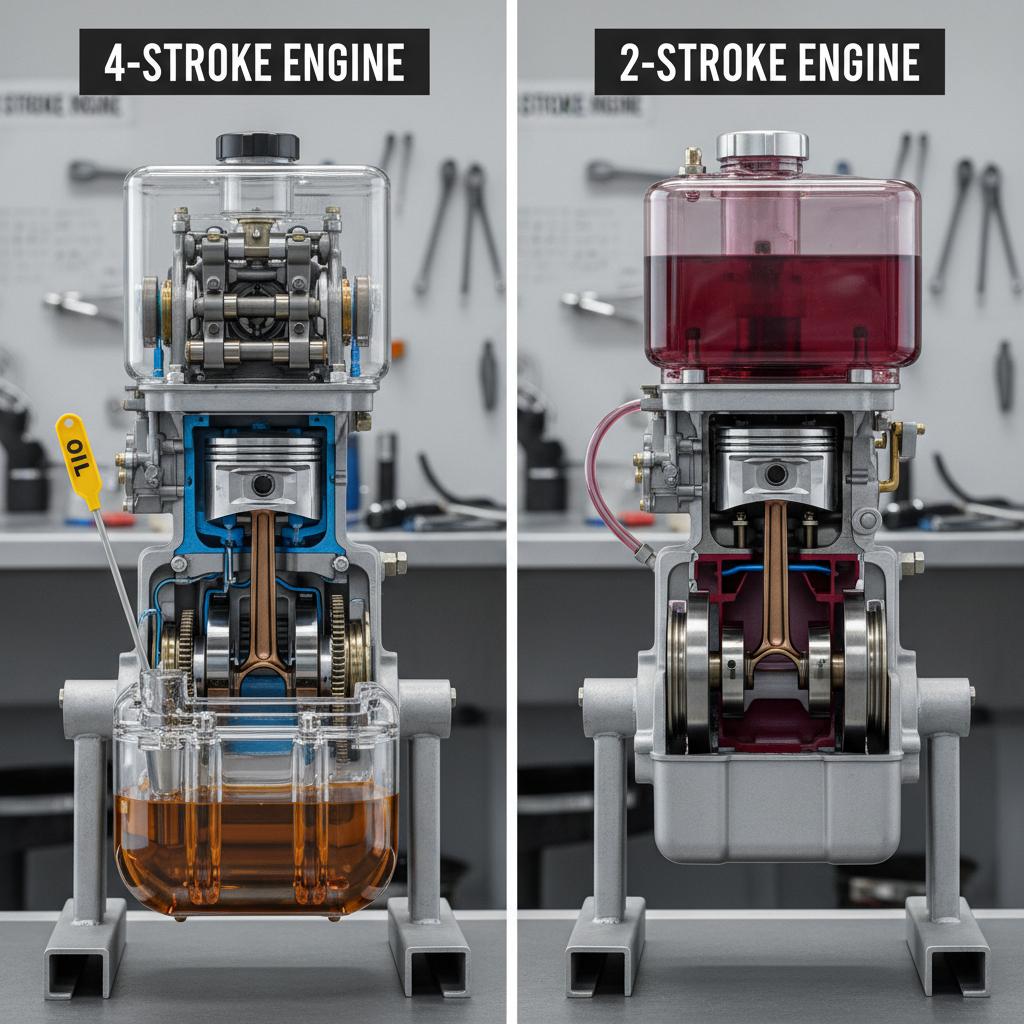
The first step in selecting the right oil is identifying your lawn mower’s engine type, as 4-stroke and 2-stroke engines have fundamentally different oil requirements.
How to Identify Your Engine Type
A 4-stroke engine has a separate oil reservoir and dipstick. You check and top up the oil level independently from the fuel tank. Most residential lawn mowers manufactured in the last 20 years are 4-stroke.
A 2-stroke engine has no separate oil reservoir. Instead, oil is mixed directly into the fuel before it enters the tank—typically at a ratio of 1 part oil to 50 parts fuel (or 1:50), though some engines use 1:40 or other ratios. If your mower requires you to mix oil into the fuel, you have a 2-stroke engine.
Why Engine Type Matters
4-stroke engines use motor oil to lubricate moving parts within the engine block. The oil circulates continuously, clings to components, and drains back to the reservoir. Over time, the oil breaks down and requires periodic changes.
2-stroke engines burn oil as part of the fuel mixture, so they consume it entirely during operation. Pre-mixing fuel and oil eliminates the need for a separate lubrication system but requires precise ratios to avoid engine damage from insufficient lubrication or fouled spark plugs from excess oil.
Oil Viscosity Grades Explained: SAE 30 vs. 10W-30
Oil viscosity refers to thickness—how easily oil flows at different temperatures. The SAE (Society of Automotive Engineers) viscosity grade indicates this property.
Understanding SAE 30
SAE 30 is a straight-weight oil with a single viscosity rating. It flows easily when warm but thickens significantly in cold conditions. SAE 30 is ideal for lawn mowers used primarily in warm climates or during summer months. In cold weather, SAE 30 becomes too thick to circulate properly, potentially causing starting problems or inadequate lubrication during engine startup.
Understanding 10W-30
10W-30 is a multi-grade oil with two viscosity ratings separated by the “W” (winter). The “10W” indicates the oil’s cold-flow rating—how well it pours in winter conditions. The “30” indicates its hot viscosity rating at operating temperature. The “W” means the oil meets winter flow standards, typically down to -4°F or lower.
10W-30 remains pourable in cold conditions while maintaining adequate protection at higher temperatures. This makes it suitable for year-round use in most North American regions.
Selecting the Right Grade for Your Climate
| Climate / Season | Recommended Grade | Notes |
|---|---|---|
| Warm/Tropical Climates | SAE 30 | Standard choice; excellent protection in heat |
| Temperate Regions (Most of US) | 10W-30 | Best year-round option; covers spring through fall plus winter storage |
| Cold Climates | 5W-30 or 0W-30 | If 10W-30 not listed, use lower winter rating; check manual first |
| Seasonal Use (Summer Only) | SAE 30 | Cold-flow rating irrelevant if mowing only in warm months |
Synthetic vs. Conventional Oil for Small Engines
Conventional Motor Oil
Conventional oil is refined from crude petroleum and treated with additives for corrosion protection and viscosity stability. It’s the standard choice for most lawn mowers and remains the most affordable option. Conventional SAE 30 or 10W-30 oils designed for small engines typically cost $5–$15 per quart.
Conventional oils require more frequent changes—typically every 50 hours of operation or annually, whichever comes first—because they break down faster under heat stress.
Synthetic and Synthetic-Blend Oil
Synthetic oil is chemically engineered to provide superior performance across a wider temperature range and longer service life. Synthetic oils resist oxidation better, maintain viscosity more consistently, and typically extend drain intervals to 100+ hours or annually.
Synthetic-blend oil mixes conventional and synthetic base stocks, offering some synthetic benefits at a lower cost than full synthetic.
Can You Use Synthetic Oil in Your Mower?
Yes, synthetic or synthetic-blend oils are compatible with most modern 4-stroke lawn mowers and can be used immediately. Check your owner’s manual—if it lists SAE 30 or 10W-30 without restrictions, synthetic versions in the same grade are acceptable. Some older mowers may specify conventional oil only; if so, stick with conventional.
Benefits and Trade-offs
- Synthetic oil advantages: Better cold-flow performance, longer intervals between changes, improved engine cleanliness, reduced sludge buildup, better thermal stability
- Synthetic oil drawbacks: Higher upfront cost ($15–$30+ per quart); may be unnecessary for casual mowers used seasonally
- Best for: Heavy-use mowers (commercial, frequently used), older machines with sludge concerns, cold-climate regions, users preferring fewer maintenance intervals
How to Check Your Mower’s Oil Requirements
Step 1: Locate the Owner’s Manual
Your mower’s owner’s manual is the authoritative source for oil specifications. Check:
- The manual that came with your mower (often stored in a waterproof compartment)
- The manufacturer’s website using your mower’s model number (visible on a label near the engine or deck)
- A search for “[Brand] [Model] manual PDF” online
Step 2: Find the Oil Specifications Section
The owner’s manual typically includes a “Specifications” or “Maintenance” section listing recommended oil type, SAE grade, and capacity. This section may specify separate oils for different seasons or climates.
Step 3: Check the Oil Level
On 4-stroke mowers, locate the dipstick (usually a bright-colored handle on the side of the engine). Pull it out completely, wipe it clean, reinsert it fully, then pull it out again to check the level. Add oil if the level falls below the “MIN” mark on the stick, filling only to “MAX” or the fill line.
What Happens If You Use the Wrong Grade?
- Oil too thin (viscosity too low): Inadequate lubrication, increased engine wear, potential bearing damage, metal-on-metal contact
- Oil too thick (viscosity too high): Poor circulation, hard starting in cool weather, increased sludge buildup, reduced fuel efficiency
- Wrong oil type (2-stroke vs. 4-stroke): For 2-stroke engines, using straight motor oil instead of pre-mixed fuel causes carbon buildup and fouling; for 4-stroke engines, using 2-stroke oil contaminates the crankcase
Oil Change Intervals
Conventional oil in 4-stroke mowers typically requires changing every:
- 50 hours of operation, or
- Once per mowing season (spring), or
- Annually if the mower sits idle in winter
Synthetic oils may extend intervals to 100+ hours, but seasonal changes (at least once yearly before storage) are still recommended to prevent corrosion and gum formation during off-season storage.
Oil Requirements for 2-Stroke Lawn Mowers
The Oil-Fuel Mixture Ratio
2-stroke mowers require oil mixed directly into fuel before filling the tank. Common ratios include:
- 1:50 ratio (2%): Most common for modern 2-stroke mowers; 1 part oil to 50 parts fuel
- 1:40 ratio (2.5%): Used by some brands; check your manual for the exact requirement
- 1:32 ratio (3.1%): Older equipment or specific high-performance engines
Mixing incorrectly—too much oil causes spark plug fouling and blue smoke; too little causes inadequate lubrication and seizure.
What Oil to Buy for 2-Stroke Engines
Use 2-stroke engine oil specifically, not automotive motor oil. 2-stroke oils are formulated to:
- Burn cleanly without excessive residue
- Mix uniformly with fuel without separating
- Provide adequate lubrication under high-temperature combustion
2-stroke oils are widely available at hardware stores, garden centers, and online retailers, typically in small quart or pint bottles ($8–$20). Common brands include Stihl, Husqvarna, Echo, and generic small-engine brands.
Measuring and Mixing
Most 2-stroke oils include measurement caps or can be mixed using:
- A fuel can with measurement markings
- A syringe or graduated measuring cup to portion oil accurately
- Pre-mixed fuel-oil bottles available at retailers (convenience premium included)
Always mix oil and fuel thoroughly before adding to the mower’s fuel tank. Let the mixture settle for a few minutes if visible separation occurs.
Frequently Asked Questions
Can I use regular automotive motor oil in my lawn mower?
Yes, if your mower requires SAE 30 or 10W-30, standard automotive motor oil in those grades is acceptable. However, small-engine-specific oils are formulated for the cooler-running engines in lawn mowers and often include additives for better performance. Using automotive oil occasionally in an emergency is fine, but small-engine oil is preferred for regular maintenance.
How often should I change the oil in my lawn mower?
For conventional oil, change it every 50 hours of operation or once per season (typically spring before the mowing season). For synthetic oil, intervals may extend to 100+ hours. If your mower is stored for winter, change the oil before storage to prevent rust and gum formation. Check your manual for the manufacturer’s specific recommendation.
What happens if I mix up and use 4-stroke oil in a 2-stroke engine?
If you accidentally use 4-stroke motor oil as a pre-mixed fuel additive in a 2-stroke engine, the engine will quickly foul and stop. 4-stroke oil is heavier and does not burn as cleanly as 2-stroke oil, leaving excessive carbon deposits on the spark plug and piston. Drain the fuel tank, clean the spark plug, and refill with properly mixed fuel using actual 2-stroke oil.
Is synthetic oil worth the extra cost for my lawn mower?
Synthetic oil offers longer drain intervals and better temperature protection, making it worthwhile for heavy-use or commercial mowers. For homeowners mowing once weekly in moderate climates, conventional oil is typically adequate and more economical. Synthetic becomes more cost-effective if your mower runs 100+ hours annually or if you prefer to change oil less frequently.
Can I overfill the oil in my lawn mower?
No. Overfilled oil can cause the engine to smoke excessively, foul the spark plug, and create pressure that seals cannot contain. Always fill to the “MAX” mark on the dipstick. If you accidentally overfill, drain the excess oil into a container until the level reaches “MAX.”