Direct Answer: Lawn Mowing Pricing Overview
Lawn mowing typically costs $30–$80 per visit for residential properties, though rates vary by region, lawn size, and service complexity. Service providers commonly charge $0.02–$0.08 per square foot, offer monthly packages ranging from $100–$400, or use hourly rates between $40–$100 per hour. Final pricing depends on terrain, equipment needs, location, and local market demand.
Understanding Lawn Mowing Pricing Models
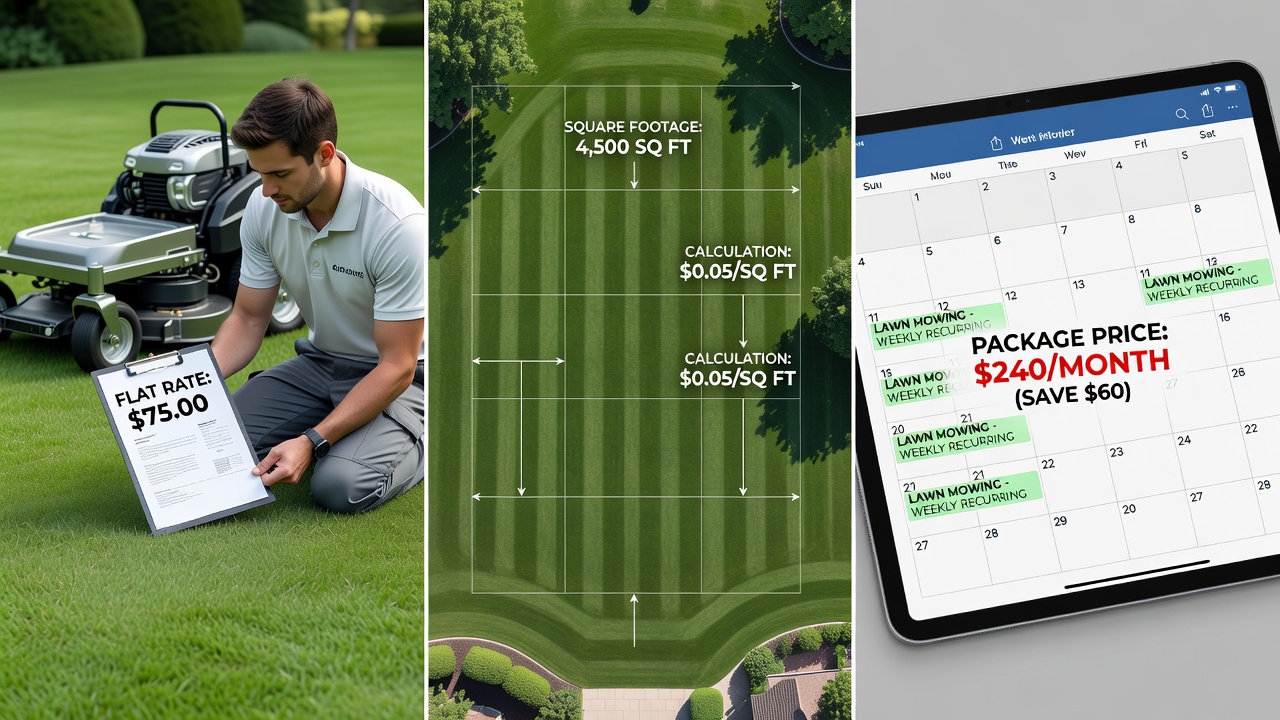
Lawn mowing services use three primary pricing approaches, each suited to different business structures and customer preferences.
Per-Visit Pricing
Per-visit pricing is the most common model for homeowners hiring occasional mowing. A service provider quotes a flat rate for a single lawn cut, typically ranging from $30–$80 depending on lawn size and regional rates. This model works well for customers who want transparency and don’t commit to long-term contracts. Service providers benefit from flexibility but may experience inconsistent revenue if customers don’t schedule regularly.
Per-Square-Foot Pricing
Many professional lawn care companies use square footage as their primary metric. Rates typically fall between $0.02–$0.08 per square foot, meaning a 5,000-square-foot lawn would cost $100–$400 per visit. This model scales fairly with property size and helps service providers quote consistently. The variation within this range reflects regional differences, terrain difficulty, and market rates.
Monthly and Seasonal Packages
Package pricing encourages recurring revenue and customer loyalty. Monthly lawn care typically costs $100–$400 depending on frequency (weekly, bi-weekly, or monthly cuts) and lawn size. Seasonal packages might offer discounted rates for spring through fall maintenance or bundle additional services like edge trimming, leaf cleanup, or fertilization. These contracts provide service providers with predictable income and customers with locked-in rates.
Hourly Rates
Some service providers charge $40–$100 per hour, particularly for complex jobs, terrain challenges, or bundled services. Hourly billing works well for properties requiring custom work or when scope is difficult to estimate upfront. However, most homeowners prefer fixed pricing for standard mowing.
Key Factors That Affect Lawn Mowing Cost
Multiple variables determine whether you fall on the lower or higher end of pricing ranges.
Lawn Size and Square Footage
Lawn size is the primary cost driver. Small residential properties (under 2,500 square feet) typically cost $25–$40 per visit, while average suburban lawns (5,000–10,000 square feet) run $50–$100. Large properties (15,000+ square feet) may exceed $150 per visit. The per-square-foot model directly scales with this variable.
Terrain and Grass Condition
Flat, well-maintained lawns are quickest to mow and command lower prices. Properties with hills, obstacles (trees, rocks, garden beds), or overgrown grass require additional time and effort, justifying higher rates. Thick, dense grass or uneven terrain may also necessitate specialized equipment or multiple passes, increasing labor costs.
Location and Regional Market Rates
Geography significantly impacts pricing. Urban and suburban areas typically have higher rates than rural regions due to increased labor costs, competition density, and customer demographics. Coastal regions and metropolitan areas often run 20–40% higher than national averages. Local market saturation also affects rates—highly competitive markets may see lower prices, while underserved areas command premiums.
Travel Time and Distance
Service providers in concentrated residential areas can maximize efficiency by serving multiple properties in one route. Conversely, rural or dispersed properties require more travel time, often reflected in higher per-visit costs or minimum service charges. Some providers add travel surcharges ($10–$25) for properties beyond their primary service area.
Equipment and Maintenance Costs
Commercial-grade mowers, trimmers, and maintenance equipment represent significant overhead. Providers pricing their services must account for equipment depreciation, fuel, maintenance, and storage. These fixed costs often influence minimum service charges and justify higher per-square-foot rates compared to hobbyists with minimal equipment investment.
Service Frequency
Weekly mowing contracts are typically cheaper per visit than one-time cuts, as providers maintain customers on predictable schedules. Bi-weekly or monthly services fall between these extremes. Off-season services (fall cleanup, spring preparation) often command higher rates due to increased labor intensity.
Pricing by Region and Market
Urban and Suburban Areas
Metropolitan and suburban regions typically charge $50–$100 per visit for average lawns, with per-square-foot rates at the higher end ($0.06–$0.08). High population density, elevated labor costs, and strong customer demand support these premiums.
Rural and Regional Variations
Rural areas often see $30–$60 per visit, with lower per-square-foot rates ($0.02–$0.04). However, properties tend to be larger, potentially offsetting the lower rate per square foot. Travel distances may also introduce surcharges.
Geographic Cost Drivers
Northeast and West Coast: Higher costs due to elevated labor rates and cost of living. Expect $60–$100+ per visit in major metros.
Midwest and South: Moderate pricing, typically $40–$70 per visit. More affordable than coastal regions.
Rural areas nationwide: Lower rates ($25–$50) but may include travel minimums or surcharges.
Setting Competitive Rates as a Service Provider
Calculate Your Baseline Costs
Start by determining your true cost per hour, including labor, equipment depreciation, fuel, maintenance, insurance, and overhead. If mowing a 7,500-square-foot lawn takes 45 minutes and your total hourly cost is $50, your base cost is approximately $37.50. A reasonable profit margin (30–50%) suggests charging $48–$56 for that job. Compare this against local market rates to ensure competitiveness.
Develop a Pricing Formula
Use per-square-foot pricing as your foundation, then adjust for terrain, distance, and local demand. Example formula:
- Base rate: $0.04 per square foot
- Flat terrain, standard maintenance: $0.04–$0.05
- Hilly or obstacles: $0.06–$0.07
- Overgrown or severely unkempt: $0.08–$0.10
- Distance surcharge: Add $10–$25 if beyond your primary service area
Offer Tiered Pricing
Create packages to encourage recurring revenue and customer retention:
- Single mow: Standard per-visit rate
- Bi-weekly package: 10% discount off per-visit rate
- Weekly package: 15–20% discount, ensuring consistent revenue
- Seasonal bundle: Mowing + edge trimming + cleanup at fixed monthly price
Account for Hidden Costs
Include non-mowing time in your pricing: travel, scheduling, billing, equipment maintenance, and occasional no-shows. If you spend 30% of your time on non-billable tasks, your per-hour revenue must cover these inefficiencies. Adjust rates accordingly.
Monitor and Adjust
Track actual time spent on each job type and compare against your quotes. If jobs consistently exceed estimated duration, adjust your pricing upward. Conversely, if you’re underutilized, consider promotional pricing or bundled services to attract volume.
Comparing Costs as a Homeowner
What to Expect in a Standard Mowing Service
A basic lawn mowing service includes cutting grass to a consistent height, removing clippings, and cleanup. Most providers quote based on lawn size and frequency. Before hiring, clarify:
- Is edging and trimming included, or are they add-ons?
- What is the mowing height, and can it be adjusted?
- Are clippings bagged or mulched?
- Is the quote valid for year-round service, or does it change seasonally?
- What is the cancellation or rescheduling policy?
Premium Add-On Services
Beyond basic mowing, providers often offer:
- Edging and line trimming: $10–$30 additional
- Leaf blowing and cleanup: $15–$40
- Fertilization: $50–$150 depending on lawn size
- Weed control: $75–$200 per application
- Dethatching or aeration: $100–$300
Ways to Reduce Costs
- Commit to a seasonal package: Monthly contracts offer 10–20% savings versus per-visit rates.
- Bundle services: Combining mowing with other lawn care often reduces per-service cost.
- Choose bi-weekly instead of weekly: Less frequent cuts cost less per month overall.
- Maintain your lawn between visits: Well-maintained lawns mow faster, potentially reducing quotes.
- Ask about seasonal discounts: Some providers offer winter rates or spring promotions.
Getting Accurate Quotes
To receive competitive bids, provide service providers with:
- Lawn square footage or dimensions
- Photos showing terrain, obstacles, and grass condition
- Your preferred mowing schedule (weekly, bi-weekly, etc.)
- Desired add-on services
Request 2–3 quotes before hiring. Compare not only price but also reputation, equipment condition, and professionalism.
Frequently Asked Questions
What is the average cost of lawn mowing per square foot?
Typical per-square-foot rates range from $0.02–$0.08, with most service providers charging $0.04–$0.06. Rates vary by region, terrain difficulty, and market demand. Urban and suburban areas generally fall at the higher end, while rural regions are lower.
How much should I charge if I’m starting a lawn mowing business?
Begin by calculating your true hourly costs (labor, equipment, fuel, overhead), then apply a 30–50% profit margin. For most new providers, starting rates of $0.04–$0.05 per square foot or $40–$60 per visit for average-sized lawns are competitive. Research local market rates and adjust based on your experience, equipment quality, and service area.
Is weekly lawn mowing more expensive than bi-weekly?
Weekly mowing costs more per visit than bi-weekly service, but when comparing weekly rates over a month, weekly service is often cheaper per cut due to package discounts. For example, weekly service might be $50 per cut ($200/month) while bi-weekly is $65 per cut ($260/month). Discuss package pricing with your service provider.
Do lawn mowing rates include edge trimming and cleanup?
Not always. Basic per-visit rates typically cover mowing only. Edge trimming, line trimming, and leaf blowing are often quoted as add-ons at $10–$40 extra. Always confirm what’s included in your quote before committing to a service.
Conclusion
Lawn mowing costs vary widely based on region, lawn size, service model, and market conditions. Homeowners should expect to pay $30–$80 per visit for standard residential mowing, while service providers can establish competitive rates using per-square-foot ($0.02–$0.08), per-visit, or monthly package models. Understanding local market rates, accounting for terrain and distance factors, and comparing multiple quotes ensures fair pricing for both customers and professionals. Whether you’re hiring or launching a lawn care business, aligning rates with your local market, service quality, and true cost structure is essential for long-term success.