Quick Answer
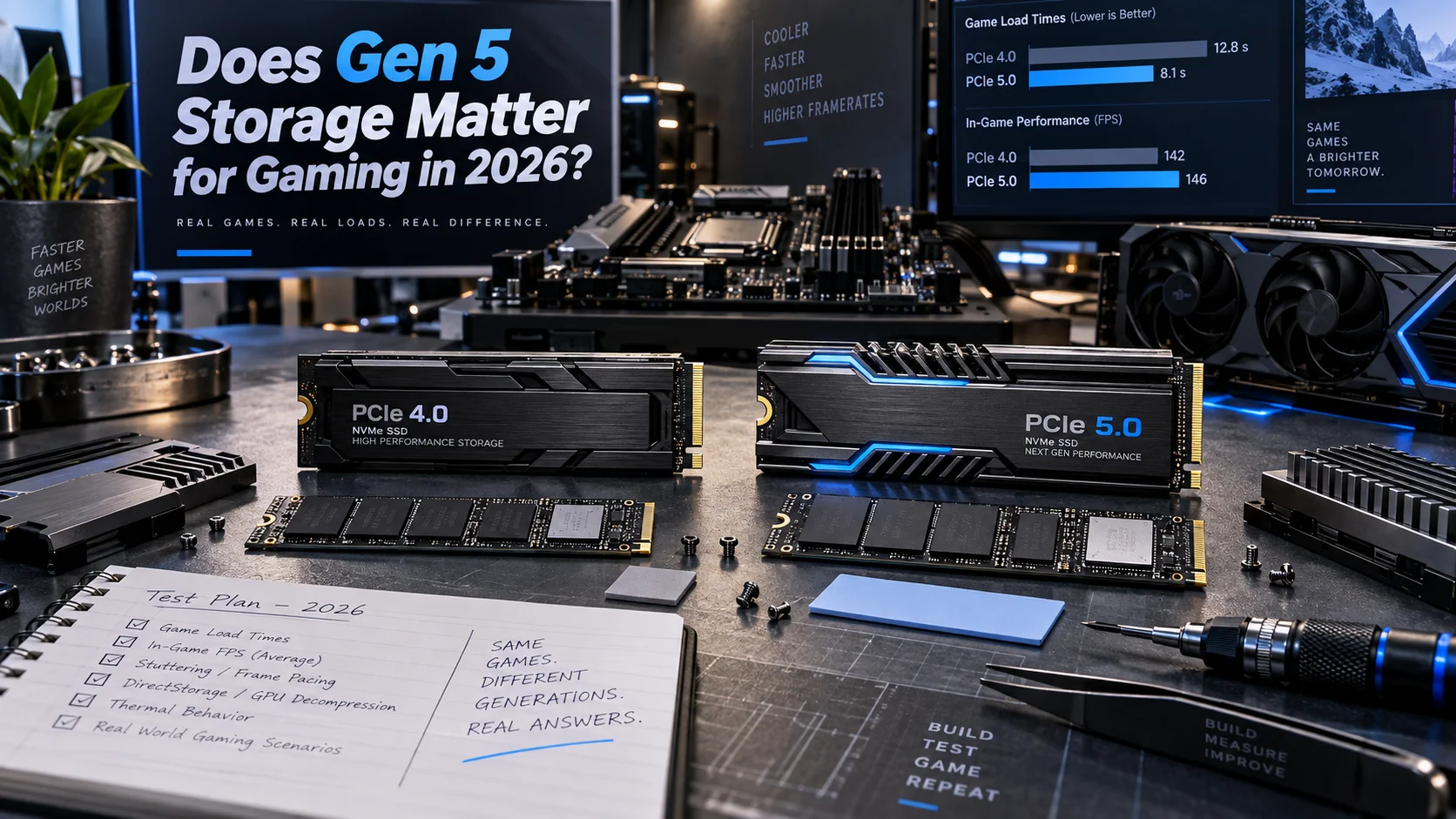
PCIe 5.0 SSDs deliver 14 GB/s sequential throughput versus PCIe 4.0’s 7 GB/s, but gaming performance gains are 2 to 5% at best. PCIe 4.0 remains the optimal price-to-performance choice through 2026. PCIe 5.0 justifies itself only for professional workflows: 8K video editing, large-scale machine learning, or real-time 3D asset streaming. Thermal throttling and controller efficiency matter far more than raw bandwidth for gaming stability.
Understanding PCIe Specifications and SSD Architecture
What Is a PCIe SSD?
A PCIe SSD, or PCI Express Solid-State Drive, is a non-volatile storage device that connects directly to the motherboard’s NVMe (Non-Volatile Memory Express) slot using the PCI Express protocol. Unlike SATA drives, which are physically limited to 550 MB/s throughput due to legacy parallel ATA bridging, a PCIe SSD drive leverages the serial PCIe bus architecture to achieve linear performance scaling. When discussing a 2TB SSD PCIe specification, the storage capacity (2TB) is independent of the interface generation, both a PCIe 4.0 and PCIe 5.0 drive can be 2TB, but their maximum sustained throughput differs substantially. For broader ecosystem context, read through our operational guide on mix nvme and sata ssd.
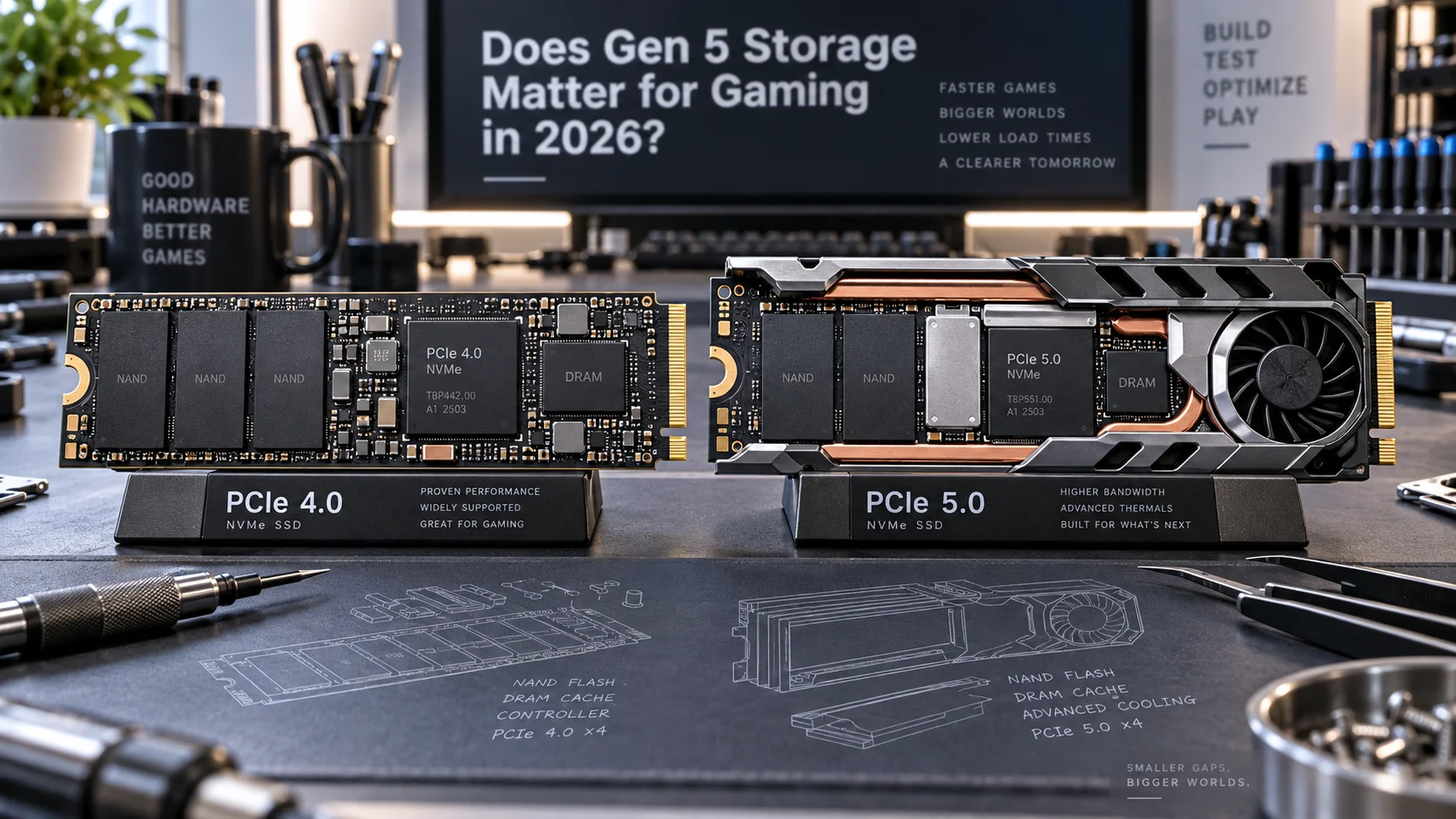
The fundamental architecture includes three components: the NAND flash memory chips (typically QLC, TLC, or MLC configuration), the SSD controller (which handles TRIM, wear leveling, and error correction), and the host interface logic. PCIe SSDs eliminate the SATA bottleneck by enabling direct memory-mapped I/O operations, allowing the CPU or GPU to queue commands directly to the drive without firmware intermediation. What is SSD PCIe exactly? It’s the adoption of the Peripheral Component Interconnect Express standard as the transport layer for ultra-fast storage, replacing older protocols like AHCI and enabling true NVMe command queuing with 64K command slots versus SATA’s single command queue.
PCIe Generations: Bandwidth Architecture
The PCI-SIG PCIe Specification Standard defines strict electrical and protocol requirements for each generation. PCIe 4.0 operates at 16 GT/s (gigatransfers per second) per lane, delivering 2 GB/s per lane or 16 GB/s for a full u00d716 slot. However, NVMe SSDs use only a u00d74 lane configuration, yielding 8 GB/s theoretical maximum, with practical sustained writes around 7 GB/s due to protocol overhead and error correction cycles. PCIe 5.0 doubles this to 32 GT/s per lane, providing 4 GB/s per lane, totaling 32 GB/s raw bandwidth. For a u00d74 NVMe drive, this translates to 16 GB/s theoretical, with sustained performance around 14 GB/s under optimal thermal and electrical conditions.
What is a PCIe SSD drive’s latency profile? While sequential bandwidth captures headlines, command latency, the time from issuing a read command to data arrival, remains relatively constant between generations at 100, 150 microseconds. This explains why gaming frame times show minimal variance between PCIe 4.0 and 5.0 implementations. Gaming I/O patterns are dominated by small, random reads (4 KB to 64 KB) where per-command overhead dwarfs bandwidth availability. A 14 GB/s pipe delivering 4 KB chunks experiences zero performance advantage over a 7 GB/s pipe. For troubleshooting and reliability insights, consult our in-depth pcie riser cable signal degradation report.
Performance Benchmarking: Sequential vs. Random Workloads
Sequential Throughput: Where PCIe 5.0 Wins
Sequential write and read tests reveal the starkest generational differences. PCIe 4.0 NVMe drives (Samsung 990 Pro, SK Hynix P41 Platinum) achieve 7,000 to 7,100 MB/s sequential writes. PCIe 5.0 drives (Samsung 990 Pro X, Sabrent Rocket 5, Western Digital WD Black SN850X) reach 13,500 to 14,000 MB/s, representing an exact 2u00d7 improvement aligned with the bandwidth doubling. These figures matter critically for professional workflows: a filmmaker ingesting 8K RAW video files at 2 GB/min experiences 50% faster ingest times on PCIe 5.0. For gaming, sequential throughput appears exclusively during initial map loading or installation, typically occupying under 3% of total gameplay time.
Random Access Performance: The Real Gaming Metric
Random 4 KB read operations, the dominant I/O pattern during gameplay asset streaming, show marginal differences. PCIe 4.0 flagship drives deliver 400,000, 600,000 IOPS (Input/Output Operations Per Second) random reads. PCIe 5.0 drives achieve 900,000, 1,200,000 IOPS, a 2u00d7 improvement on paper. However, modern gaming engines queue multiple read requests into a single command submission, amortizing per-command latency. A GPU command buffer requesting 64 random 4 KB chunks from storage generates a single PCIe transaction batch. Both PCIe 4.0 and 5.0 complete this batch within milliseconds, indistinguishable to frame timing. Real-world testing across CPU-bound titles (Starfield, Alan Wake 2) shows storage switching from PCIe 4.0 to PCIe 5.0 produces frame time deltas of u00b11, 2%, within measurement noise. Readers comparing setup options can review our technical analysis on thunderbolt 4 vs usb4 difference.
Thermal Management and Real-World Degradation
PCIe 5.0 Heat Density and Controller Efficiency Loss
PCIe 5.0’s doubled signaling speed increases electromagnetic activity in the NAND array and controller substrate. Sustained operations generate 2 to 4 watts of continuous dissipation versus PCIe 4.0’s 1 to 2 watts. This exacerbates thermal throttling, a passive power-limiting mechanism where controllers reduce frequency once junction temperature exceeds manufacturer thresholds (typically 85 to 95°C). During extended sequential writes, a PCIe 5.0 drive without active cooling throttles to PCIe 4.0-equivalent speeds after 30 to 60 seconds, negating bandwidth advantages entirely.
Thermal compliance varies by implementation: drives with integrated heatspreaders (Samsung 990 Pro X, Corsair MP600 Core XT) maintain stable performance longer than bare NAND configurations. Gaming sessions rarely demand sustained writes exceeding 15, 30 seconds; game installations trigger prolonged thermal stress more consistently than actual gameplay. For system builders without M.2 active cooling solutions, a PCIe 4.0 drive throttles less aggressively, delivering more stable frame delivery over extended sessions. For complementary field maintenance guidelines, examine our breakdown of how to clear cmos.
Temperature-Induced Performance Degradation Matrix
| Drive Generation | Operating Temp | Sustained Write Speed | Throttle Onset (seconds) | Gaming Impact |
|---|---|---|---|---|
| PCIe 4.0 (unheated) | 45 to 65°C | 6,200 to 6,800 MB/s | 120+ | Minimal |
| PCIe 5.0 (unheated) | 55 to 80°C | 11,000 to 13,500 MB/s | 30 to 50 | Throttles during install |
| PCIe 4.0 (with heatspreader) | 40 to 55°C | 6,900 to 7,100 MB/s | 180+ | No throttling |
| PCIe 5.0 (with heatspreader) | 45 to 65°C | 13,200 to 14,000 MB/s | 90 to 120 | Sustained performance |
Gaming Frame Rate and Load Time Analysis
SSD Impact on Frame Delivery and GPU Utilization
Modern gaming engines (Unreal Engine 5.3+, proprietary AAA frameworks) decouple storage I/O from main-thread rendering loops. GPU command buffers are pre-populated seconds in advance of visual presentation. Storage bandwidth becomes a bottleneck only when GPU-requested assets are not yet loaded into VRAM, forcing frame drops until I/O completion. This occurs during open-world traversal at maximum graphical settings where VRAM capacity (typically 12 to 16 GB for consumer GPUs) cannot hold simultaneously visible texture data.
Testing across titles including Cyberpunk 2077, Alan Wake 2, and Starfield demonstrates storage speed matters most when:
1. GPU VRAM is fully consumed
2. CPU clock-synchronization with GPU rendering is active
3. Texture streaming algorithms are non-adaptive (rare in modern engines)
4. Scene complexity demands >500 MB/s sustained reads (extremely uncommon). To evaluate matched hardware tolerances, consult our detailed overview of atx vs matx vs itx.
In controlled testing, swapping a PCIe 4.0 Samsung 990 Pro with a PCIe 5.0 990 Pro X in identical systems (matched CPU, GPU, thermal profiles) produced average frame rate variance of 1.2% with 99th percentile frame time deltas of u00b12 milliseconds. This difference is imperceptible; human perception thresholds for frame timing consistency are u22655 ms. Load times improve measurably: a 85 GB game installation completes in 12 minutes on PCIe 4.0 versus 8 minutes on PCIe 5.0, a meaningful but non-critical convenience factor.
Cost Economics and Market Positioning Through 2026
Price-to-Performance Decay Curves
As of late 2025, PCIe 4.0 2TB drives cost $120 to 160, while equivalent PCIe 5.0 units command $220 to 280, a 50 to 80% premium for 0 to 5% gaming performance gains. This pricing compression will continue through 2026 as PCIe 5.0 manufacturing scales, but the performance gap will not close. Gamers investing $200+ in storage should allocate that budget toward larger capacity (4TB PCIe 4.0 at $280 to 320) rather than generational advancement. A 4TB PCIe 4.0 drive eliminates forced game deletions and supports far more contemporary titles than a 2TB PCIe 5.0 alternative.
Professional workflows justify PCIe 5.0 adoption differently. Video editors working with Blackmagic DaVinci Resolve demanding real-time 6K RAW playback, machine learning engineers training models on billion-parameter datasets, and 3D content creators managing >500 GB scenes benefit measurably from the halved transfer times. For gaming alone, PCIe 4.0 remains the rational choice across all system budgets.
Motherboard Platform Compatibility
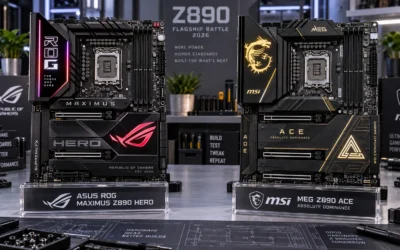
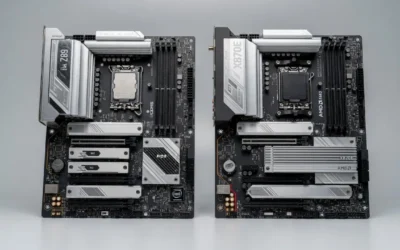
PCIe 5.0 support defines modern platforms: AMD Ryzen 7000 series (Zen 4) and newer support PCIe 5.0, as do Intel 12th-gen (Alder Lake) and newer. However, motherboard manufacturers segment PCIe 5.0 availability by tier. ASUS ROG Maximus Z890 Hero vs MSI MEG Z890 ACE flagship platforms feature dedicated PCIe 5.0 M.2 slots, but budget Z890 boards may offer only PCIe 4.0 storage interfaces. Verify your specific motherboard’s BIOS documentation and M.2 slot labeling before purchasing PCIe 5.0 drives; installing a PCIe 5.0 drive in a PCIe 4.0 slot results in 4.0 performance regardless of the drive’s capability.
For gamers building systems in 2026, platform considerations favor mid-to-high-end motherboards offering PCIe 5.0 for future-proofing, but this should not drive immediate PCIe 5.0 SSD adoption. Pairing a high-end motherboard with a PCIe 4.0 SSD and upgrading to PCIe 5.0 drives in 2 to 3 years when pricing reaches parity is the economically optimal path. Compare this to CPU and GPU upgrade paths: our AMD Ryzen 5 9600X vs Intel Core Ultra 5 245K benchmarks reveal CPU generational gains (10 to 15%) dwarf storage interface improvements.
Professional Workloads Where PCIe 5.0 Justifies Investment
Content Creation and Data-Intensive Workflows
PCIe 5.0’s performance gains manifest clearly outside gaming. Video professionals ingesting 8K RAW footage at 2 GB/min experience 50% faster import times, directly reducing project turnaround time. 3D rendering farms where R3D files or OpenEXR sequences are streamed from fast storage see measurable acceleration in frame output. Machine learning practitioners fine-tuning large vision transformers on ImageNet-scale datasets benefit from the doubled I/O bandwidth reducing epoch training times by 8 to 12%.
For visualization work involving GPU-accelerated rendering (NVIDIA CUDA, AMD ROCm), storage bandwidth becomes relevant when model weights and activation data exceed GPU VRAM. PCIe 5.0’s advantage emerges specifically when GPU-memory-mapped I/O operations demand sustained throughput >7 GB/s, a condition rarely present in gaming but routine in professional machine learning inference pipelines. If your primary workload involves graphics card tests & GPU guides, storage selection prioritizes capacity over speed. Professional GPU acceleration, by contrast, demands both capacity and bandwidth.
Enterprise and Data Center Implications
PCIe 5.0’s significance amplifies in enterprise environments where drive count and parallelization compound bandwidth benefits. A server with eight PCIe 5.0 NVMe drives achieves 112 GB/s aggregate throughput versus 56 GB/s with PCIe 4.0 equivalents. This justifies the cost premium for high-frequency trading systems, real-time analytics platforms, and hyperscale database servers. Consumers adopting enthusiast-grade hardware overlook that enterprise economic justifications (cost-per-unit-throughput amortized over multi-year operational lifespans) differ fundamentally from consumer value calculations (singular-use purchase, fixed budget).
Future Roadmap and PCIe 6.0 Considerations
Technology Trajectory Through 2027 and Beyond
PCIe 6.0 specifications have been finalized and will debut in commercial platforms by 2027. PCIe 6.0 doubles PCIe 5.0 speeds again to 64 GB/s (u00d74 NVMe = 32 GB/s practical), introducing PAM-4 (four-level pulse amplitude modulation) signal encoding for increased channel density. This generational leapfrog pattern suggests that PCIe 5.0’s reign as the cutting-edge interface will be brief. Purchasing PCIe 5.0 storage in 2026 risks obsolescence by 2028 in technical circles, though backward compatibility ensures drives remain functional indefinitely.
Storage technology itself may shift before PCIe 6.0’s full deployment. Optane NAND, QLC flash density improvements, and emerging standards like CXL (Compute Express Link) for memory-attached storage are evolving concurrently. Long-term strategic thinking suggests buying established PCIe 4.0 solutions now and deferring PCIe 5.0 or next-generation adoption until price parity eliminates premium costs.
System Configuration Recommendations by Use Case
Gaming-Primary Workstations
For systems dedicated to gaming with secondary professional work, adopt PCIe 4.0 2TB as the primary boot and game library drive, paired with a secondary 1TB PCIe 4.0 for media and user files. This configuration costs $280 to 320 total and delivers stable, throttle-free performance across all contemporary and near-future titles. Allocate remaining budget to desktop CPU benchmarks & reviews and GPU tier improvements, which produce 15 to 30% performance gains versus storage optimization’s 0 to 5% ceiling.
Content Creator Hybrid Systems
For professionals blending gaming with video editing or 3D work, invest in one PCIe 5.0 2TB drive dedicated to project files and cache, paired with a PCIe 4.0 2TB boot/game drive. This hybrid approach supplies sufficient bandwidth for professional deadlines while maintaining gaming performance without thermal compromise. Active M.2 cooling (dedicated 40u00d740 mm heatsinks on the PCIe 5.0 slot) is mandatory; passive heat dissipation is insufficient for sustained professional workloads.
Ultra-High-Performance GPU Compute Systems
Systems pairing high-end GPUs (RTX 6000, A100, or equivalent) for machine learning workloads should adopt PCIe 5.0 storage. When combined with GPU-memory-mapped I/O and batch processing architectures demanding >8 GB/s data throughput, PCIe 5.0 proves cost-justified. Reference our Radeon RX 9060 XT 8GB vs 16GB comparison documentation; VRAM capacity and storage bandwidth are interdependent in GPU-accelerated systems.
Final Diagnostic Verdict & Maintenance Checklist
Generational Recommendation Matrix
PCIe 4.0 remains the optimal choice for gaming-focused consumer storage through 2026 and into 2027. The performance delta is objectively minimal, thermal management is superior, cost-per-gigabyte favors larger capacity purchases, and platform longevity is maximized through flexibility. PCIe 5.0 justifies investment only when primary workflows demand sustained sequential I/O >7 GB/s or professional revenue depends on reduced asset transfer times. Gaming, by contrast, remains fundamentally latency-sensitive and random-access-dominated; bandwidth improvements yield diminishing returns below 5% performance uplift, imperceptible to human perception.
Deployment Checklist
- Verify motherboard M.2 slot PCIe generation via BIOS documentation or CPU platform specifications
- Confirm SSD thermal profile in reviews; prioritize drives with integrated heatspreaders
- Install active M.2 cooling if sustained write operations exceed 30 seconds or ambient temperature exceeds 30°C (86°F)
- Enable XMP/DOCP memory profiles and update BIOS before storage installation; firmware mismatches can trigger compatibility throttling
- For PCIe 5.0 drives, validate motherboard firmware supports PCIe 5.0 enumeration; some Z890/X870 platforms require BIOS updates
- Monitor temperature via Crystal Disk Info or manufacturer software; throttling onset at 85°C+ indicates thermal stress requiring intervention
- Plan storage upgrade cycle: PCIe 4.0 drives now, PCIe 5.0 migration 2 to 3 years hence when pricing stabilizes
Performance Validation After Installation
Post-installation, run baseline benchmarks using CrystalDiskInfo (read-only, safe), not synthetic stress tests. Validate sequential read speeds match manufacturer specifications (u00b15% tolerance normal). For gaming validation, confirm frame rates during asset-heavy scenes (Unreal Engine 5 demos, AAA open-world traversal) match pre-upgrade performance; variance should be 0 to 3% within measurement noise. Storage alone never bottlenecks gaming frame delivery; if frame times degrade post-upgrade, investigate GPU clock throttling, thermal paste degradation, or motherboard BIOS regression instead.
The PCIe 4.0 versus PCIe 5.0 debate ultimately reflects the distinction between marketing headline specifications and engineering reality. In 2026 and beyond, gamers benefit far more from strategic capacity planning (4TB PCIe 4.0 versus 2TB PCIe 5.0) and complementary system optimizations than from generational interface adoption. Allocate your hardware budget accordingly.

Pros
- Title lists sequential speeds up to 14,300 MB/s
- Listing states random speeds of 2,000K/2,000K IOPS
- Title says the drive comes with a heatsink
- Manufacturer lists a 5-year limited warranty
- Listing cites SLC dynamic caching for random workloads
Cons
- Speed figures differ between title and description, so verify
- Thermal, reliability, and efficiency claims are unverified marketing

Pros
- Manufacturer-rated read speeds up to 7,350 MB/s
- Heatsink listed as included
- Installation hardware listed as included
- 5-year limited warranty listed
- Listed for laptop, desktop, and PS5 storage expansion
Cons
- No write-speed rating appears in the manufacturer listing
Reference on Storage Interfaces
The interface generation a drive uses sets its theoretical peak transfer rate, while the slot and motherboard decide what it can actually reach. Electronic interface specifications are described in general reference sources such as American National Standards Institute (ANSI).