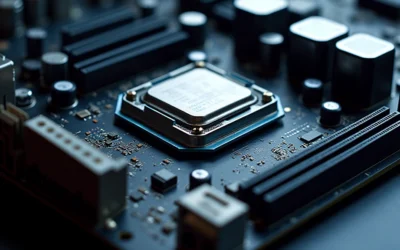
CPU temperature management stands as one of the most critical performance and longevity variables in modern gaming systems. Whether you’re running a high-end AMD Ryzen 5 9600X vs Intel Core Ultra 5 245K or a mainstream processor, thermal thresholds directly impact stability, lifespan, and sustained gaming performance. Understanding what constitutes safe operating temperatures—and how to monitor them in real-time—separates competent builders from system owners facing unexpected crashes, throttling, or catastrophic hardware failure.
Quick Answer
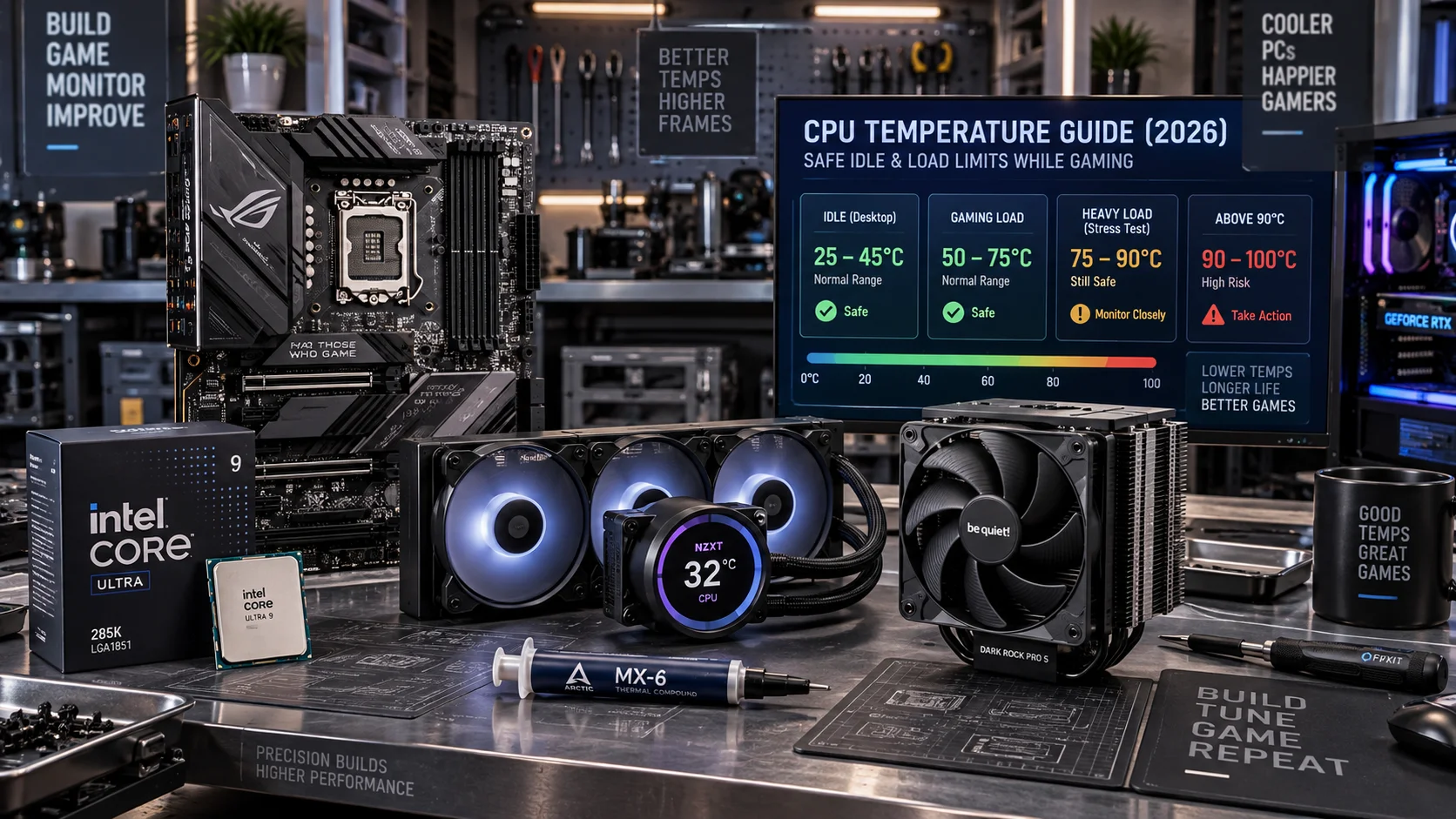
Ideal gaming CPU temps: 65–75°C under full load (stable, optimal). Safe maximum: 80–95°C depending on architecture. Idle: 30–45°C. Modern CPUs throttle at 90–105°C to prevent damage. Monitor via HWiNFO64, Ryzen Master, or Intel XTU to know the temp of cpu in real-time and maintain headroom for thermal spikes.
Understanding CPU Temperature Architecture & Thermal Design Power (TDP)
Every processor ships with a maximum operating temperature ceiling, typically published as Tjunction or Tcase in official specifications. This thermal boundary represents the die junction temperature at which the CPU will begin aggressive throttling to protect silicon integrity. Modern architectures—whether AMD Zen 5, Intel Core Ultra, or current-generation Ryzen—employ dynamic thermal management that automatically reduces clock speed and voltage when core temps exceed manufacturer thresholds, trading performance for survival.
Thermal Design Power (TDP) & Heat Output Correlation
Thermal Design Power (TDP) quantifies average heat dissipation under sustained workload, measured in watts. A 105W TDP processor dissipates roughly 105 watts of thermal energy that your cooler must remove. Higher TDP doesn’t automatically mean higher temps—it depends entirely on cooler capacity and mounting pressure. A premium 280mm liquid cooler will maintain lower temps on a 105W CPU than a stock air cooler. When you’re evaluating platform choices like the ASUS ROG Maximus Z890 Hero vs MSI MEG Z890 ACE, verify both the motherboard’s VRM thermal handling and its stock cooler provisions.
Tjunction vs. CPU Package Temperature Distinction
Thermal monitoring software may display multiple temperature readings. Tjunction represents the hottest core on the die; CPU Package averages all cores. Ryzen CPUs typically show Tjunction as the critical value, while Intel reports CPU Package Temperature. The key distinction: peak Tjunction can exceed average package temp by 10–15°C, so monitor both metrics for accurate thermal diagnosis.
Safe Temperature Ranges: Idle, Gaming Load, & Thermal Limits
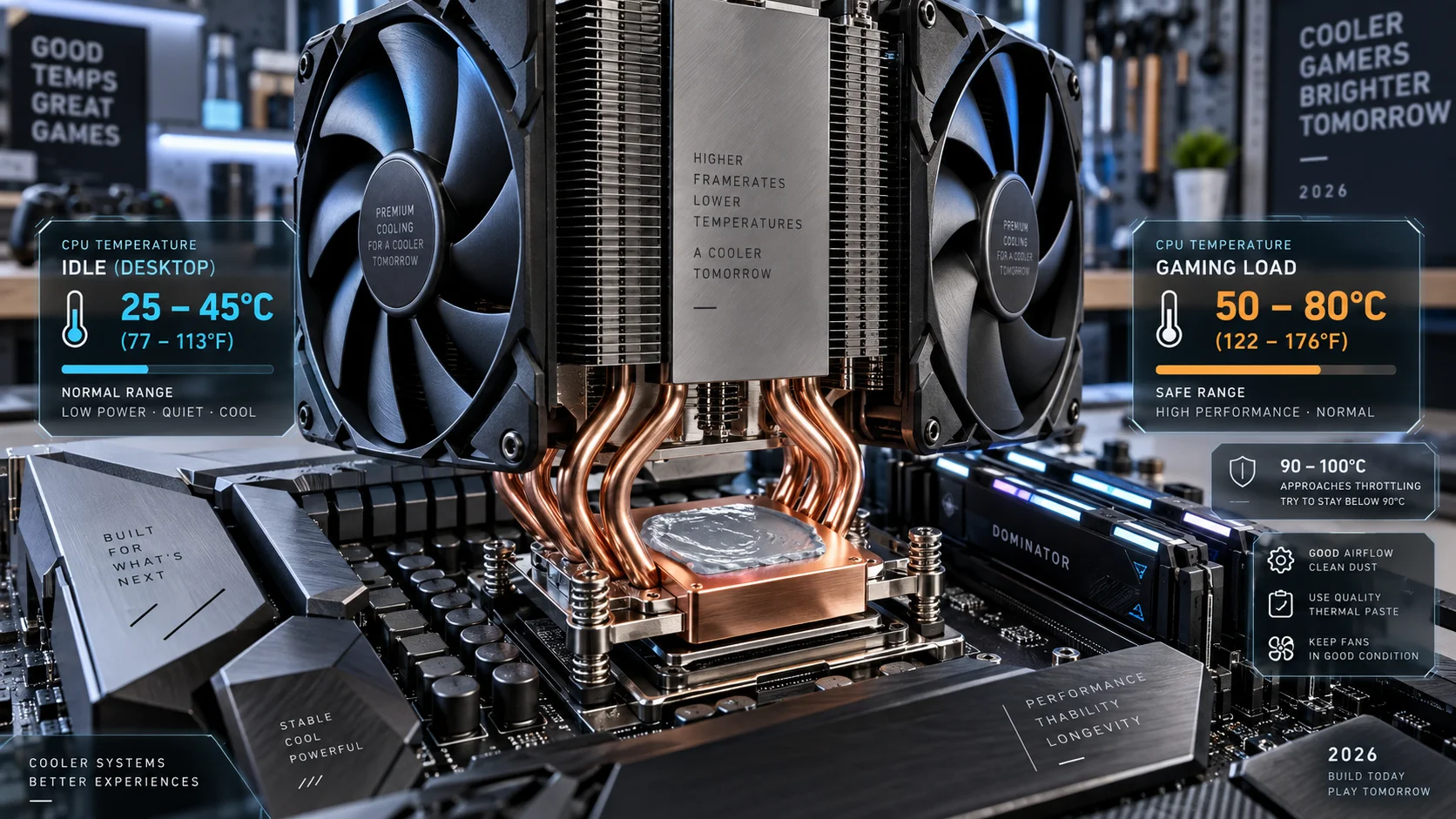
Temperature thresholds vary by architecture and generation, but industry-wide patterns establish clear performance bands and safety boundaries. Gaming workloads differ fundamentally from synthetic stress testing—real gameplay introduces thermal transients where core temps spike and settle cyclically rather than holding constant maximums.
| Thermal State | Safe Range (°C) | Optimal Gaming Target (°C) | Action Required If Exceeded |
|---|---|---|---|
| Idle (OS boot, desktop) | 30–50°C | 35–42°C | Verify BIOS power settings; check cooler mounting |
| Light Load (web browsing, office apps) | 40–60°C | 45–55°C | Monitor for spike triggers; baseline acceptable |
| Gaming Load (sustained 30+ min) | 65–85°C | 70–80°C | Stable; acceptable long-term operation |
| Heavy Load (max OC stress test) | 80–95°C | 85–92°C | Acceptable for <4 hours; upgrade cooler if sustained |
| Thermal Throttling Point | 95–105°C | N/A—shutdown imminent | Immediate cooler replacement or BIOS adjustment required |
Sustained vs. Peak Temperature Differentiation
Gaming temps exhibit natural variance. A spike to 82°C during a 10-second combat sequence differs dramatically from holding 82°C continuously for six hours. Sustained high temperatures accelerate capacitor degradation and solder joint stress, reducing CPU lifespan. Transient peaks—even into the high 80s—are tolerable if the average over a full gaming session remains 70–75°C. Use monitoring software to capture average temps over 10+ minute intervals rather than obsessing over instantaneous peaks.
How to Tell Your CPU Temperature: Real-Time Monitoring Tools & Methods
Knowing what temp should my cpu be is worthless without accurate measurement. Multiple tools deliver precise thermal telemetry; selecting the right one depends on your OS, CPU architecture, and monitoring depth preference. To get temperature of cpu accurately, leverage dedicated hardware monitoring software rather than relying on BIOS display or vague system tray indicators.
HWiNFO64: Industry Standard Thermal Diagnostics
HWiNFO64 stands as the de facto standard for Windows-based CPU thermal monitoring. This free utility reads temperatures directly from chipset sensors, displaying Tjunction, Tcase, per-core temps, VRM voltages, and historical min/max values. Launch HWiNFO in sensor-only mode alongside your game to establish accurate thermal profiles. Export CSV logs to identify thermal patterns—if your CPU consistently hits 88°C in a specific game, your cooler selection may be marginal for that workload.
AMD Ryzen Master & Intel XTU Native Monitoring
AMD processors benefit from Ryzen Master, which natively reports Ryzen-specific thermal metrics and allows voltage/frequency tuning. Intel systems should employ Intel XTU (Extreme Tuning Utility) or third-party tools—Intel Architecture Technical Documentation specifies that native Intel monitoring may underreport actual junction temps compared to hardware-level sampling. How to know the temp of cpu with manufacturer tools: launch the utility, select the Monitoring tab, and observe Core temps during gameplay for minimum 20 minutes to establish valid thermal ceiling.
BIOS Temperature Readout Limitations
BIOS-reported temps are often delayed 2–4 seconds behind actual junction temps due to firmware polling intervals. Never rely exclusively on BIOS display for load monitoring. Verify cooler function and thermal paste application, but defer to real-time OS monitoring software for accurate thermal diagnosis. How to know cpu temperature during gaming: exit to desktop immediately after 30 minutes of play, open HWiNFO, and compare real-time temp against your cooler’s rated capacity.
Diagnosing Excessive CPU Temperatures: Root Cause Analysis
When gaming temps persistently exceed 85°C at moderate ambient temps (20–22°C), systematic troubleshooting prevents premature hardware failure and preserves performance headroom. Most thermal issues trace to cooler deficiency, thermal paste degradation, or BIOS misconfiguration rather than inherent CPU faults.
Thermal Paste Application & Cooler Mounting Pressure
Thermal paste degradation or insufficient mounting pressure represents the #1 cause of elevated temps in established systems. Paste hardens after 12–24 months under thermal cycling, reducing conductivity and increasing interfacial resistance. If your CPU ran stable at 72°C two years ago but now hits 82°C under identical workload and ambient conditions, thermal paste has likely degraded. Remount your cooler with fresh paste—even premium coolers see 4–6°C temp drops after re-pasting with fresh compound. Apply paste using the “rice grain” method (pea-sized dot in center), allowing mounting pressure to distribute evenly rather than squeezing paste toward die edges.
Airflow Architecture & Case Thermal Dynamics
CPU coolers operate optimally within positive or neutral case pressure, where intake fans slightly exceed exhaust capacity. Negative pressure (exhaust > intake) forces coolers to draw hot exhaust air recirculated inside the case. If your system exhibits 8–12°C higher temps than peer reviews report for identical hardware, verify case fan configuration: front intake fans drawing cool ambient air, rear and top exhausts extracting heat, with net slightly positive or balanced pressure. GPU heat—especially with high-end discrete cards like those in our Radeon RX 9060 XT 8GB vs 16GB comparison—radiates toward CPU cooler fins, raising CPU temps by 4–7°C in tight layouts.
BIOS Power Delivery & Voltage Stability Settings
Aggressive BIOS settings—loose LLC (Load Line Calibration), high frequency offsets, or elevated voltages—increase heat output independent of cooler capacity. Modern CPUs ship with conservative defaults maximizing thermal headroom. If you’ve enabled any overclocking features, reset BIOS to factory defaults, retest temps, then re-enable modifications incrementally while monitoring thermal response. Excessive voltage multiplies heat generation non-linearly: a 50mV overvolt can increase heat output by 8–15% depending on frequency.
Gaming-Specific Thermal Patterns & Expected Temperature Behavior
Professional gaming sessions reveal distinct thermal signatures. Understanding normal vs. problematic patterns prevents unnecessary component replacement and identifies genuine cooling deficiencies.
Thermal Transients During Gameplay
Modern games exhibit CPU workload volatility. During menu navigation or cutscenes, CPU clocks downshift, temps drop 15–20°C. Intense combat sequences trigger all cores at maximum frequency, causing rapid temp spikes. Seeing 65°C on the menu and 82°C in-game is normal thermal behavior. Problematic signals include: temps climbing steadily throughout a gaming session despite stable ambient conditions (indicating cooler saturating), frame rate stutters coinciding with temp spikes above 95°C (thermal throttling), or unrecoverable temperature rise even after closing the game (cooler mounting failure).
CPU-Bound vs. GPU-Bound Thermal Characteristics
CPU-intensive titles (strategy games, simulation engines, physics-heavy workloads) generate higher CPU temps while GPU utilization remains moderate. GPU-bound games (extreme resolution, maximum ray-tracing) heat the GPU primarily, with CPU temps stabilizing 10–15°C lower than CPU-centric workloads. When comparing systems across desktop CPU benchmarks & reviews, test on identical game titles to ensure fair thermal comparison—a CPU reviewed in a GPU-bound title will report 8–12°C lower temps than the same CPU in a CPU-bound workload.
Optimizing Cooler Selection & Thermal Upgrade Path
If gaming temps consistently exceed 82°C after ruling out thermal paste degradation and airflow issues, your cooler capacity has reached its limit for your workload. Strategic cooler upgrades reduce temps 8–15°C while future-proofing against next-generation CPU heat output increases.
Air Cooler vs. Liquid Cooler Thermal Efficiency
Premium air coolers (Noctua NH-D15, Thermalright Peerless Assassin) deliver 80–85% of liquid cooler performance at fraction of cost and complexity. 280mm or 360mm AIO liquid coolers reduce temps 5–10°C versus high-end air coolers on identical hardware, with superior performance under sustained loads over 4+ hours. Select cooler based on your CPU’s TDP plus 30% thermal safety margin: a 105W TDP CPU benefits from a cooler rated 140W+ capacity. Pairing a high-performance motherboard like the ASUS ROG Maximus Z890 Hero vs MSI MEG Z890 ACE with an undersized cooler negates the platform’s performance potential.
Case Upgrade & Chassis Thermal Optimization
If case airflow remains constrained despite cooler upgrade, chassis redesign may be necessary. Modern cases prioritize aesthetics over thermal efficiency; upgrading to cases with dedicated CPU airflow chambers or mesh front panels reduces CPU temps 4–6°C independently of cooler selection. Ensure replacement case accommodates your cooler height (typically 140–170mm for premium air coolers) and supports minimum 3u00d7intake + 2u00d7exhaust fan configuration for optimal pressure balance.
Final Diagnostic Verdict & Maintenance Checklist
CPU temperature management safeguards both immediate gaming stability and long-term hardware longevity. Establish your baseline thermal signature during first two weeks of ownership using HWiNFO64 or manufacturer monitoring tools, capturing average temps across your regular gaming library. A CPU running 70–75°C under typical gaming loads indicates well-matched cooler capacity and healthy thermal interface. Temps climbing into 85–90°C suggest thermal degradation or airflow constraint; temps exceeding 92°C demand immediate cooler intervention to prevent premature failure.
Monthly thermal maintenance protocol:
- Monitor CPU temps during peak gameplay; record max core temp after 30+ minute sessions
- Compare against historical baseline; 5°C or greater increase signals thermal paste aging or dust accumulation
- Inspect case air filters monthly; clean with compressed air if visibly restricted
- Every 18–24 months, consider re-pasting cooler if sustained load temps exceed 80°C
- Verify BIOS power settings haven’t drifted toward aggressive profiles during BIOS updates
- Test identical games quarterly to establish statistical trend; gradual 1–2°C per-year increase is normal, rapid jumps indicate maintenance requirement
Understanding what temp should my cpu be transforms you from reactive troubleshooter into proactive system steward. Consult graphics card tests & GPU guides to ensure balanced thermal ecosystem—aggressive GPU cooling paired with undersized CPU cooler creates regional hot spots that compromise processor longevity. Your CPU’s operational temperature directly determines frame time stability, feature longevity, and resale value; thermal management deserves equal priority to performance specifications during hardware selection and system maintenance.