Quick Answer
Standard RGB heatspreaders measure 44–55 mm tall and will physically foul the inner fan of most dual-tower coolers. Low-profile sticks (u226432 mm) clear universally. Measure from the CPU socket centerline to the nearest DIMM slot edge, then subtract the cooler manufacturer’s published RAM clearance figure — any overhang fails, regardless of brand marketing claims.
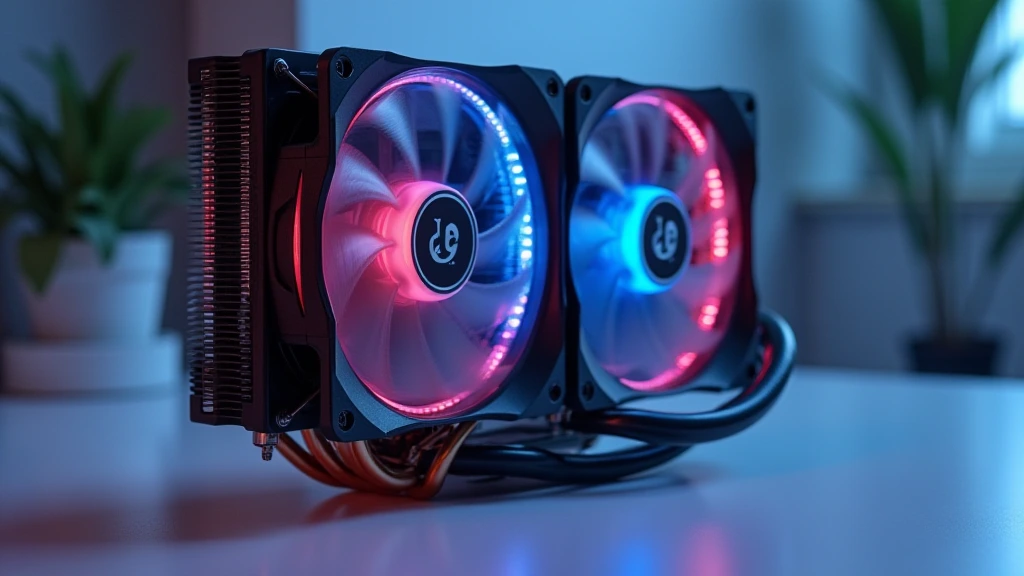
RAM clearance on air coolers is a structural geometry problem, not a preference debate. Dual-tower coolers with front-facing fin stacks — Noctua NH-D15, DeepCool Assassin IV, be quiet! Dark Rock Pro 5 — position their inner tower directly above DIMM slots 1 and 2 on ATX boards. When a 44 mm or taller RGB heatspreader occupies those slots, the inner fan’s blade plane intersects the DRAM module, forcing either fan removal, fan offset, or hardware damage during installation. This ram clearance air cooler guide dissects the exact mechanical tolerances, explains why motherboard socket offset geometry compounds the problem on Intel LGA1851 versus AMD AM5 platforms, and gives you a concrete decision matrix before you spend money on either a new cooler or a new kit of RAM.
Why Dual-Tower Coolers Create a Structural Clearance Conflict
A dual-tower cooler achieves its thermal advantage by maximizing fin surface area across two discrete aluminum or copper fin stacks connected by shared heatpipes. The inner tower — the one facing the DRAM slots — sits between 30 mm and 55 mm from the CPU socket centerline on most ATX and mATX motherboard layouts, depending on platform socket size and PCB routing constraints. The JEDEC Memory Standards Specification sets unbuffered DIMM (UDIMM) module height at 30.48 mm (1.200 inches) as the baseline for non-heatspreader modules. Every millimeter added above that baseline — heatspreader fins, RGB diffusers, polymer light pipes — encroaches on the gap between the DIMM slot and the bottom edge of the cooler’s inner fan frame.
The 120 mm Fan Frame Geometry Problem
A standard 120 mm fan mounts on a 105 mm u00d7 105 mm frame. With standard 4 mm rubber anti-vibration pads, the blade plane sits roughly 6–8 mm inside the outer frame boundary. When a cooler lists “40 mm RAM clearance,” it is measuring from the PCB surface (not the DIMM slot floor) to the lowest point of the inner fan frame — not the blade plane. Blades themselves may clear by only 2–3 mm in practice. Heatspreader fins with angular cuts or angled lighting diffusers can bridge that gap physically even when the published spec suggests otherwise. Always measure the tallest physical protrusion on a heatspreader, including any LED lens caps at the module corners.
Socket Offset Asymmetry: LGA1851 vs AM5
Intel’s LGA1851 socket on Z890 motherboards positions the socket centerline approximately 42 mm from the nearest DIMM A2 slot edge on standard ATX layouts. AMD AM5 on X670E and B650 pushes that gap to roughly 38–40 mm due to the narrower socket land grid and PCB routing differences. This means an identical dual-tower cooler produces different effective DRAM clearance on an Intel build versus an AMD build — typically 4–6 mm less clearance on AM5. Builders choosing between platforms should factor this asymmetry early. If you are comparing CPUs for a performance build, review the AMD Ryzen 5 9600X vs Intel Core Ultra 5 245K comparison, which addresses platform-level build considerations including thermal solution compatibility.
Heatspreader Height Classifications and Real-World Stack Measurements
The market segments into three practical height tiers. Understanding each tier’s physical profile determines which cooler categories are viable without modification.
Tier 1: Low-Profile (u226432 mm)
Modules such as the G.Skill Aegis, Kingston Fury Beast (non-RGB standard), and Crucial Pro sit at 32–33 mm. These clear virtually every dual-tower cooler on the market without fan offset. Thermal performance of the heatspreader at this height is adequate for DDR5-6000 and DDR4-4000 and below, since modern DRAM ICs at those speeds do not generate enough junction heat to require aggressive aluminum fin arrays. Choosing Tier 1 is the zero-compromise path for dual-tower cooler builds.
Tier 2: Standard Heatspreader (34–44 mm)
This tier includes the majority of mid-range RGB kits — G.Skill Trident Z5 Neo, Corsair Vengeance RGB, Kingston Fury Beast RGB. Heights in this range will clear some dual-tower coolers with published RAM clearance figures of 45 mm or more, but only if the heatspreader profile is flat-topped. Angular fin cuts and protruding LED lenses on G.Skill Trident Z Neo RGB, for example, add 2–4 mm of effective protrusion height beyond the published spec sheet value. Always cross-reference pcpartpicker community build photos for your exact cooler/kit combination.
Tier 3: Tall RGB (45 mm and above)
G.Skill Trident Z Royal, Corsair Dominator Platinum RGB, and T-Force Xtreem ARGB reach 44–55 mm. These are physically incompatible with the inner fan of dual-tower coolers in standard mounting position on most ATX motherboards. The only legitimate workarounds are: removing the inner fan entirely (thermal penalty of 3–8°C under sustained AVX load), offsetting the inner fan upward by one fan slot (retains ~80% of airflow across the lower fin stack), or replacing the RAM kit with a Tier 1 module. Aesthetic preference is not a valid engineering constraint when it compromises airflow geometry.
Comprehensive RAM Clearance Specification Matrix
| Cooler Model | Published RAM Clearance | Inner Fan Removable | Fan Offset Option | Safe Heatspreader Max (Measured) | Platform Notes |
|---|---|---|---|---|---|
| Noctua NH-D15 | 40 mm | Yes | Yes (asymmetric mount) | 38 mm (flat top) | LGA1851 safe; AM5 marginal at 38 mm |
| Noctua NH-D15G2 | 38 mm | Yes | Yes | 36 mm (flat top) | Tighter than D15 on AM5 due to heatpipe routing |
| DeepCool Assassin IV | 45 mm | Yes | Yes | 43 mm (flat top) | Best-in-class clearance for dual-tower category |
| be quiet! Dark Rock Pro 5 | 40 mm | Yes | Limited (non-standard clip) | 38 mm (flat top) | Proprietary fan clips restrict offset options |
| Thermalright Phantom Spirit 120 SE | 48 mm | Yes | Yes | 46 mm (flat top) | Budget leader; clears most Tier 2 RGB kits |
| Thermalright Peerless Assassin 120 SE | 45 mm | Yes | Yes | 43 mm (flat top) | Popular $40–$50 performer; solid clearance margin |
| Scythe Fuma 3 | 42 mm | Yes | Yes | 40 mm (flat top) | Asymmetric design aids clearance natively |
| Noctua NH-U12A (single-tower, dual-fan) | 93 mm | Yes | Yes | Universal — all Tier 3 kits clear | Single-tower reference; ~3–6°C penalty vs NH-D15 |
Note: “Measured” safe max values reflect community-verified real-world clearance, accounting for fan frame intrusion and blade plane proximity. Subtract an additional 2 mm on AM5 platforms due to socket offset geometry discussed above. For motherboard-level context on high-end Z890 builds, the ASUS ROG Maximus Z890 Hero vs MSI MEG Z890 ACE comparison details DIMM slot positioning differences between those two boards that directly affect these clearance figures.
Fan Offset Strategy: Thermal Cost Analysis
Fan offset — sliding the inner fan upward by one fan slot position (typically 15–25 mm) — is the most common field fix when a Tier 2 heatspreader borderlines the clearance spec. The thermal cost is not uniform across cooler designs and requires understanding of fin stack airflow distribution.
Why Offset Works (and Where It Fails)
Dual-tower fin stacks are not thermally uniform along their vertical axis. The lower third of the fin stack, directly above the CPU IHS, carries the highest heatpipe heat flux and benefits most from direct fan airflow. When an inner fan is offset upward, the lower fin section loses forced convection but retains passive convection and cross-flow from the outer fan’s exhaust side. Empirical data from community testing on the NH-D15 shows a 3–5°C increase in peak CPU temperature under sustained Cinebench R24 multithread load with the inner fan offset by 20 mm versus flush-mounted. Under light gaming loads (30–50% CPU utilization), the delta narrows to 1–2°C — practically negligible. The offset strategy is thermally acceptable for gaming and productivity workloads, but inadvisable for sustained AVX-512 compute, video encoding workloads exceeding 10 minutes, or any overclocked configuration pushing beyond 200W package power.
Single-Tower Fallback and Performance Context
If the build demands tall RGB heatspreaders and full sustained compute performance, a high-end single-tower cooler — the Noctua NH-U12A, Thermalright Frozen Prism 360 (AIO), or comparable — eliminates the clearance problem entirely while delivering competitive thermals. The NH-U12A sits roughly 3–6°C behind the NH-D15 in dual-fan configuration across 200W+ loads, which is acceptable for most non-overclocked or modestly overclocked scenarios. Single-tower coolers in the $50–$70 range from reputable manufacturers frequently match or exceed the NH-D15’s thermal performance per dollar when paired with high-static-pressure fans, making the “dual-tower is mandatory” assumption worth revisiting for pc hardware 2026 builds where DDR5 kit heights have standardized higher across the market.
Does Low-Profile RAM Actually Hurt Performance?
This is the most persistent misconception in the ram clearance air cooler community. Low-profile modules at u226432 mm use the same Samsung B-die, Hynix A-die, or Micron Rev.E ICs as their tall RGB counterparts. The heatspreader is a cosmetic and supplementary thermal accessory — DDR5 JEDEC spec at 6000 MT/s generates approximately 2.5–3.5W per module at full sustained bandwidth utilization. That heat load dissipates adequately through a 32 mm aluminum spreader bonded directly to the IC substrate. No thermal throttling occurs, no latency increases from heatspreader height reduction. G.Skill’s own Aegis DDR4-3600 CL16 (32 mm) uses identical Samsung B-die binning to the Trident Z Neo at the same speed grade — the performance difference is literally zero. For deeper CPU and platform benchmarks that contextualize memory controller performance across platforms, consult our desktop CPU benchmarks & reviews section, and for GPU-bound workflows where VRAM bandwidth dwarfs system RAM throughput, see the graphics card tests & GPU guides and the Radeon RX 9060 XT 8GB vs 16GB comparison for memory configuration impact on GPU-side workloads.
XMP/EXPO Profile Compatibility Is Heatspreader-Independent
XMP 3.0 (Intel) and EXPO (AMD) profile activation is a SPD-level JEDEC function stored in the module’s serial presence detect EEPROM. It has no relationship to heatspreader height, RGB controller presence, or module form factor. A 32 mm low-profile stick with XMP 3.0 DDR5-7200 CL34 activates that profile identically to a 55 mm RGB tower kit at the same speed grade. Stability at extreme frequencies depends on IC quality and motherboard memory controller tuning — not aluminum heatspreader mass.
Pre-Purchase Measurement Protocol
Follow this sequence before ordering any cooler or RAM kit combination for a new or existing build. Skipping steps produces expensive incompatibility.
- Measure the distance from the CPU socket centerline to the outer edge of DIMM slot A1 (nearest slot to socket) using digital calipers. Record this as dimension D.
- Obtain the cooler manufacturer’s published inner tower offset from socket centerline. Subtract the inner fan frame half-width (typically 52.5 mm for a 105 mm frame). This yields the fan blade clearance zone floor above the PCB surface.
- Measure the actual tallest point of the heatspreader module including any LED lens protrusions. Do not use the manufacturer’s spec sheet — measure a physical sample or use community-verified height data from pcpartpicker or the cooler manufacturer’s compatibility list.
- If (heatspreader height) u2264 (fan frame lower edge height above PCB) u2212 3 mm, the combination is safe. The 3 mm margin accounts for manufacturing tolerance stack-up across PCB warp, socket Z-height variation, and fan pad compression.
- If the combination fails the margin test, choose: swap to Tier 1 RAM, select a cooler with a higher published clearance figure (Assassin IV, Phantom Spirit 120 SE), or apply the fan offset strategy with documented thermal expectations.
Final Diagnostic Verdict & Maintenance Checklist
The ram-clearance-air-cooler problem resolves to a single geometric rule: the heatspreader’s tallest physical point must sit at least 3 mm below the inner fan frame’s lowest edge at the cooler’s installed position. Every other factor — brand prestige, RGB sync compatibility, cooler marketing copy — is subordinate to that measurement. Low-profile RAM at u226432 mm is the structurally correct answer for dual-tower cooler builds and carries zero performance penalty. Tall RGB kits are an aesthetic choice that imposes a measurable thermal and installation complexity cost.
- Verify physically: Measure heatspreader height with calipers — never rely on spec sheets for clearance decisions.
- Account for platform offset: Subtract 2 mm from published RAM clearance on AM5 platforms versus LGA1851 for equivalent cooler models.
- Fan offset is acceptable for gaming/productivity: Confirmed 3–5°C penalty under sustained AVX load; 1–2°C under typical gaming loads.
- Do not remove inner fan without thermal testing: Run Cinebench R24 multithread for 10 minutes and log peak temperature before committing to single-fan operation.
- Low-profile modules are IC-equivalent: Speed grade and die quality determine performance — heatspreader height contributes nothing to bandwidth, latency, or OC headroom.
- XMP/EXPO functions on all form factors: Profile activation is SPD-level and heatspreader-independent.
- Re-verify after reseating cooler: Torque variation on cooler mounting screws shifts the heatsink by 0.5–1.5 mm laterally on some mounting systems; re-check clearance after any cooler removal and reinstallation cycle.
- Annual dust maintenance: Remove both fans and clean fin stacks with compressed air annually — offset fan positions accumulate debris asymmetrically, reducing airflow through the lower fin sections critical for peak thermal performance.